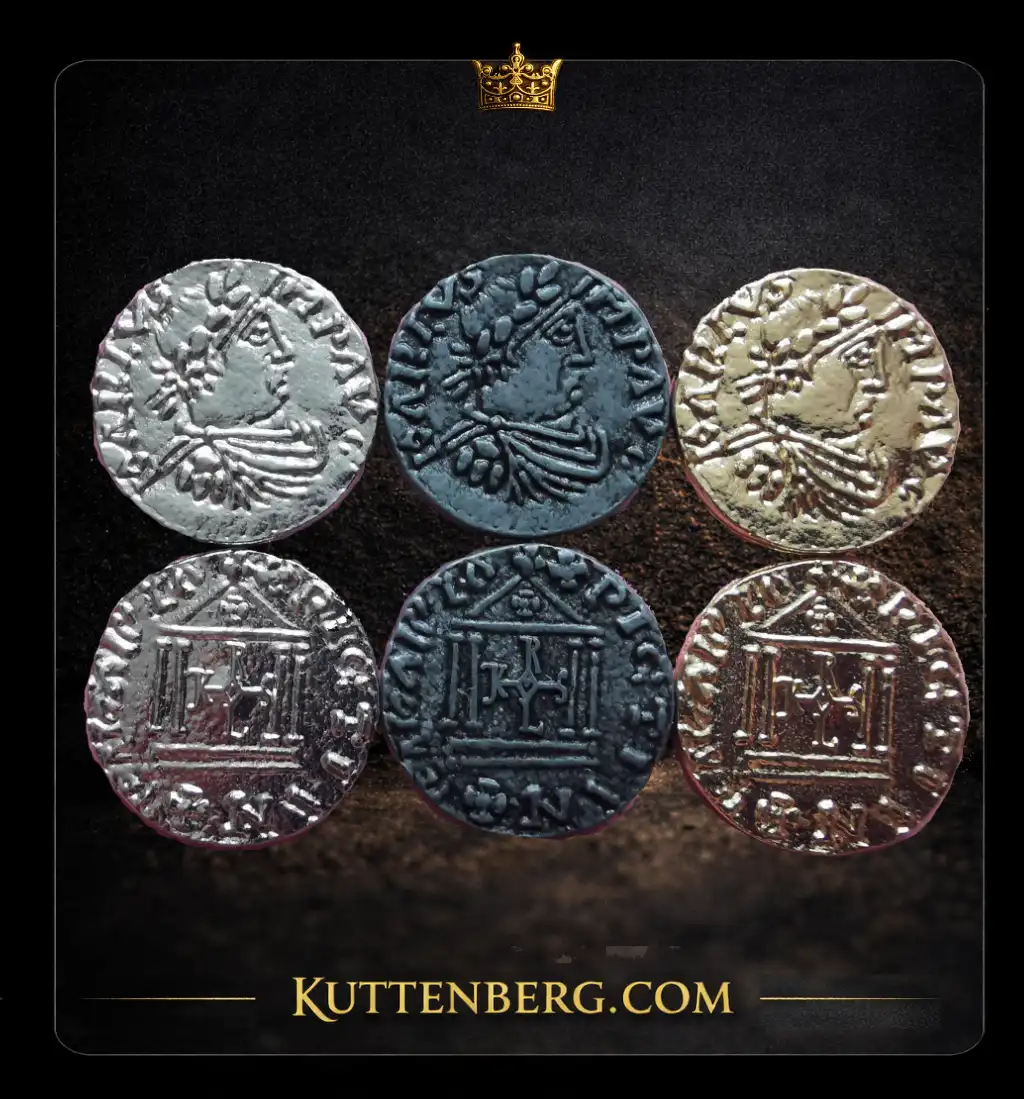
Denarius of Charlemagne – metal replica
€ 0,80
This coin is a replica of a historical denarius minted in Aachen, one of the key political and symbolic centers of Charlemagne’s empire. The denarius became the everyday currency of the early Middle Ages, and its importance quickly spread beyond the borders of the Frankish realm. Charlemagne’s monetary system became a model for much of Western Europe, and for centuries, nearly all European rulers minted their own denarii. Only in the 13th and 14th centuries did larger coin types—such as the groschen—begin to replace it on a wider scale.
Parameter Value
Diameter 25 mm
Thickness approx. 2 mm
Weight approx. 4 g
Material Zinc alloy
Color variants Silver, Gold, Iron
Suitable for LARP, RPG, board games, gifts, props, etc.
Who is the denarius coin for
It is a game coin for use in board games, cosplay, larp and rpg, in theater, etc. It is a game coin for use in board games, cosplay, larp and rpg, in theater, etc. It will be used, for example, by LARP players, RPG gamemasters, collectors of fantasy items and fans of epic mythology.
Uses of denarius
Suitable as a game currency, trophy, collector’s item or atmospheric accessory to a costume.
Denarius of Charlemagne
The denarius of Charlemagne is one of the most influential coins in European history. At the beginning of the 9th century, Charlemagne introduced a major monetary reform in the Frankish Empire, establishing the silver denarius as the fundamental—and effectively the only—standard coin of his realm. At a time when Europe’s monetary landscape was fragmented and coin quality varied widely, the unified royal denarius restored trust in money and enabled more stable trade.
This coin is a replica of a historical denarius minted in Aachen, one of the key political and symbolic centers of Charlemagne’s empire. The denarius became the everyday currency of the early Middle Ages, and its importance quickly spread beyond the borders of the Frankish realm. Charlemagne’s monetary system became a model for much of Western Europe, and for centuries, nearly all European rulers minted their own denarii. Only in the 13th and 14th centuries did larger coin types—such as the groschen—begin to replace it on a wider scale.
Charlemagne’s reform built upon Roman traditions while fundamentally transforming them. The denarius became the standard unit for accounting, taxation, and long-distance trade, forming the backbone of the medieval monetary system. For a long time, it was also the only widely minted coin—higher values often existed only as accounting units, expressed in multiples of denarii rather than as separate coins.
The typical motifs of Charlemagne’s denarii emphasize the connection between royal authority and Christian legitimacy. The coin bears Charlemagne’s monogram, serving both as a mark of authority and a simple, easily recognizable symbol. The architectural motif on the reverse reflects the stability and structure of the empire, while the cross represents the role of Christianity as the ideological foundation of Charlemagne’s rule.
The denarius model proved so successful that it became the foundation of European monetary tradition. Its name gave rise to many later terms for money, including the French denier, Italian denaro, Spanish dinero, and English penny. The denarius thus stands not only at the beginning of medieval coinage, but also at the origin of the language of European money.
The same system was adopted in Central Europe. The Přemyslid lands used a denarius-based system from their earliest coinage until the monetary reform of Wenceslas II in the late 13th century, when it was replaced by the Prague groschen. Similar developments occurred across Europe, demonstrating how deeply Charlemagne’s reform shaped everyday economic life.
The denarius of Charlemagne can therefore be seen not just as a circulating coin, but as one of the key instruments in shaping medieval Europe. It created a shared economic language that endured for centuries and influenced European currencies long after the fall of Charlemagne’s empire.
This replica is designed for LARP, board games, reenactment, and other projects where historical authenticity matters—while remaining accessible. The coin has a diameter of 24 mm and is based on real historical strikes that rank among the most iconic coins of the early Middle Ages.
Facts
- Charlemagne’s denarius formed the basis of the “denarius system,” which dominated European economies for more than four centuries.
- In most of early medieval Europe, only one denomination—the denarius—was regularly minted.
- The name “denarius” gave rise to many European words for money, including denier, denaro, dinero, and penny.
- In the Czech lands, the denarius remained the main coin until the introduction of the Prague groschen in the late 13th century.
- The denarius of Charlemagne is one of the key symbols of the transition from late antiquity to the medieval economy.
Historical authenticity
Today, we are used to currency that changes regularly, with older coins quickly disappearing from circulation. In the Middle Ages, however, things worked very differently.
Coins often remained in circulation for decades, and it was completely normal for newly minted coins to be used alongside much older ones. For example, Prague groschen were used from the 14th century well into the time of the Thirty Years’ War.
Newer coins were often smaller and contained less precious metal, but older, higher-quality coins did not disappear. On the contrary – they were often valued even more.
In times of crisis, such as the Hussite Wars, minting could stop entirely. The Kutná Hora mint, one of the most important in Europe, was inactive for extended periods, which meant that coins already in circulation continued to be used for many years.
That is why it is historically accurate for different types and ages of coins to appear together in your game world – just as they did in reality.
Shipping & Delivery
We ship worldwide from the EU.
📦 Shipping cost
Shipping is fixed based on destination.
Because shipping cost is fixed, larger orders offer significantly better value.
🌍 Customs & duties
Orders within the EU are shipped without customs fees.
Shipping to the USA
We ship to the USA via our US partner. Your order is processed locally, no customs, no extra fee, you receive it as a domestic USPS shipment.
All customs handling is taken care of on our side — you won’t need to deal with any customs fees or import procedures.
Canada: No import duties. Local taxes may apply depending on your region.
For other non-EU countries (e.g. UK, Switzerland, Norway), customs charges may apply. We list the goods as “toy parts – metal token for games”, many countries have zero customs duties on them, but we do not guarantee what your customs office will decide.
🚚 Delivery time
Europe: 3–7 business days
USA: 10–14 days
Other countries: varies depending on location
📬 Shipping method
We use trusted carriers (Packeta, DHL, Hermes, Colissimo, GLS, UPS, USPS and other partners by country).
Tracking is provided for all orders.
💡 Tip
Because the real shipping costs are the same for 10 or 100 coins, it is advantageous to order more at once.
Most customers order 30–100 coins to make the most of shipping.
Aachen — when a coin becomes certainty
The hammer fell, and the mint master let the coin rest on the table for a moment. Not because he had to—but because he wanted to see how it felt.
It was small. Simple. Precise.
“Another,” said the apprentice.
The mint master shook his head.
“Wait.”
A steward entered the room carrying a pouch of old coins and pieces of silver that had, only a few years ago, passed as money.
“This is what people carry,” he said, pouring them onto the table. Each one different. Each one questioned.
The mint master placed the newly struck denarius beside them.
“And this is what they will carry,” he replied.
The steward turned the coin between his fingers.
“They are all the same.”
“They must be,” said the mint master.
“And if someone clips it?”
The mint master smiled.
“Then they will know it was right.”
There was silence for a moment. Then the steward took a handful of new denarii and tied the pouch.
“We’ll send them to the market,” he said.
The mint master nodded.
Because a coin does not begin to exist when it is struck.
It begins to exist when people stop doubting it.
Village — the value of work
The farmer placed the coin on the table and watched it for a moment, as if expecting it to speak.
The collector moved it closer to the others. The pile was small—but clear.
“How much more?” the farmer asked.
The collector ran his finger over a wax tablet.
“Two,” he said.
The farmer nodded. He reached into his pouch and searched—not because he did not know how much he had, but because each coin represented a piece of his year.
He placed them beside the first.
“We used to weigh it,” he muttered.
“You used to argue,” the collector replied.
The farmer picked up the one denarius he had left and turned it in his fingers. The monogram was worn, but still clear.
“And is it fair?” he asked.
The collector looked at the coin.
“It is the same,” he said.
The farmer nodded. Not because he was convinced—but because he understood.
The coin disappeared back into the pouch.
Because the denarius was not just money.
It was a measure.
Identity
Verwenden Sie Silbergroschen als Standardwährung,
Gold für hohe Werte,
patiniertes Silber für Münzen mit niedrigem Wert.
Design
Specifications
Usage
RPG
Brettspiele und andere Spiele
Film- und Theaterrequisiten
Themenmärkte und ähnliche Veranstaltungen
Themen-Kinderlager
FAQ
Is the coin double-sided?
Yes, all our coins are double-sided. The denarius has a portrait Emperor Charlemagne
Is it an exact replica of the original?
Yes, it is based on the real appearance of the denarius
What is the weight of one coin?
Approximately 4 grams.
What does the denarius coin feel like?
Authentic, it is a metal coin.
Is the coin suitable for LARP or RPG?
Yes, it is made of a durable alloy and has safe rounded edges.
Is it a replica or fiction?
It is a fairly faithful historical replica created in real size based on a real coin from the time of emperor Rudolf II.
Can the coin also be used as a gift?
Yes, it is often used as a thematic trifle or collector’s item object.
Is the coin magnetic?
No
What is the lifespan of the surface treatment?
It depends on the way of use, in general – the lifespan is long.
Can the coin be used as real currency or an investment?
No — You can try, but we are afraid that you will not succeed, it has been withdrawn from circulation for a few centuries 🙂
This is a replica for games, collecting or as a prop (it is not minted from silver and has no real value as currency).
Safety Warning
This coin is not a toy.
Not suitable for children under 3 years – choking hazard (small parts).
Keep out of reach of small children.
Additional Safety Recommendations
-
The coin is metal and may be heavier than regular plastic coins tokens.
-
Do not use as an object for throwing or hitting.
-
Do not chew, do not put in mouth.
-
Not suitable for children under 3 years without adult supervision.
Coin maintenance and cleaning
Common cleaning
-
Wipe with a dry or slightly damp soft cloth.
-
If the patina is more pronounced, use a mild soap solution and dry thoroughly again.
-
Do not use abrasives or scouring pads — they can damage the surface treatment.
What not to do with a coin
-
Do not leave in moisture for a long time (you will extend the life of the patina and the surface).
-
Do not expose to aggressive chemicals (cleaning sprays, acids, acetone, polish remover).
-
Do not put in the dishwasher — heat and water pressure destroy the surface finish.
-
Do not leave in salt water (corrosive environment).
-
Do not put in pockets with keys — they quickly scratch the surface.
Long-term storage
-
Store in a dry place.
-
Ideally keep in a bag, box or envelope.
Related products
-
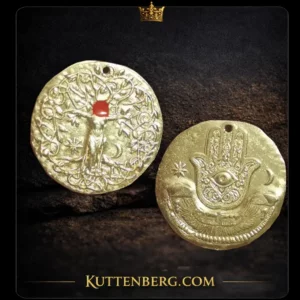
Ashera The Heavenly Mother
Price range: € 0,80 through € 8,00Select options This product has multiple variants. The options may be chosen on the product page -
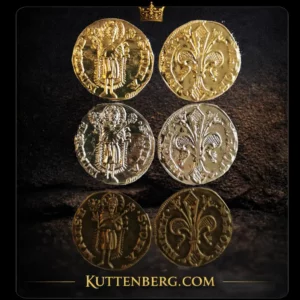
Florin – Medieval Coin Replica for Games
€ 0,80Select options This product has multiple variants. The options may be chosen on the product pagePricing and sales
Quantity Discount (%) Price 1 - 9 — € 0,80 10 - 99 25% € 0,60 100 - 499 40% € 0,48 500 - 999 50% € 0,40 1,000+ 53.75% € 0,37 -
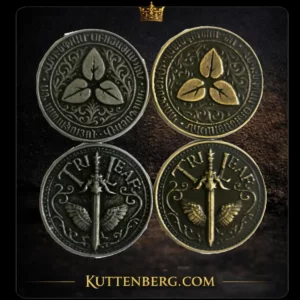
Fantasy coin Trileaf
€ 0,80Select options This product has multiple variants. The options may be chosen on the product page -
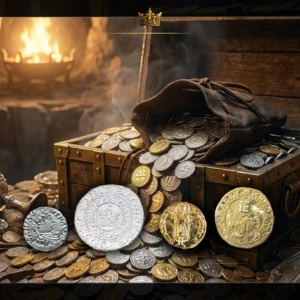
Medieval Royal Treasury – set of medieval gaming coins
Price range: € 30,00 through € 370,00Select options This product has multiple variants. The options may be chosen on the product page