Ducat of Petr Vok of Rozmberk
21,25Kč
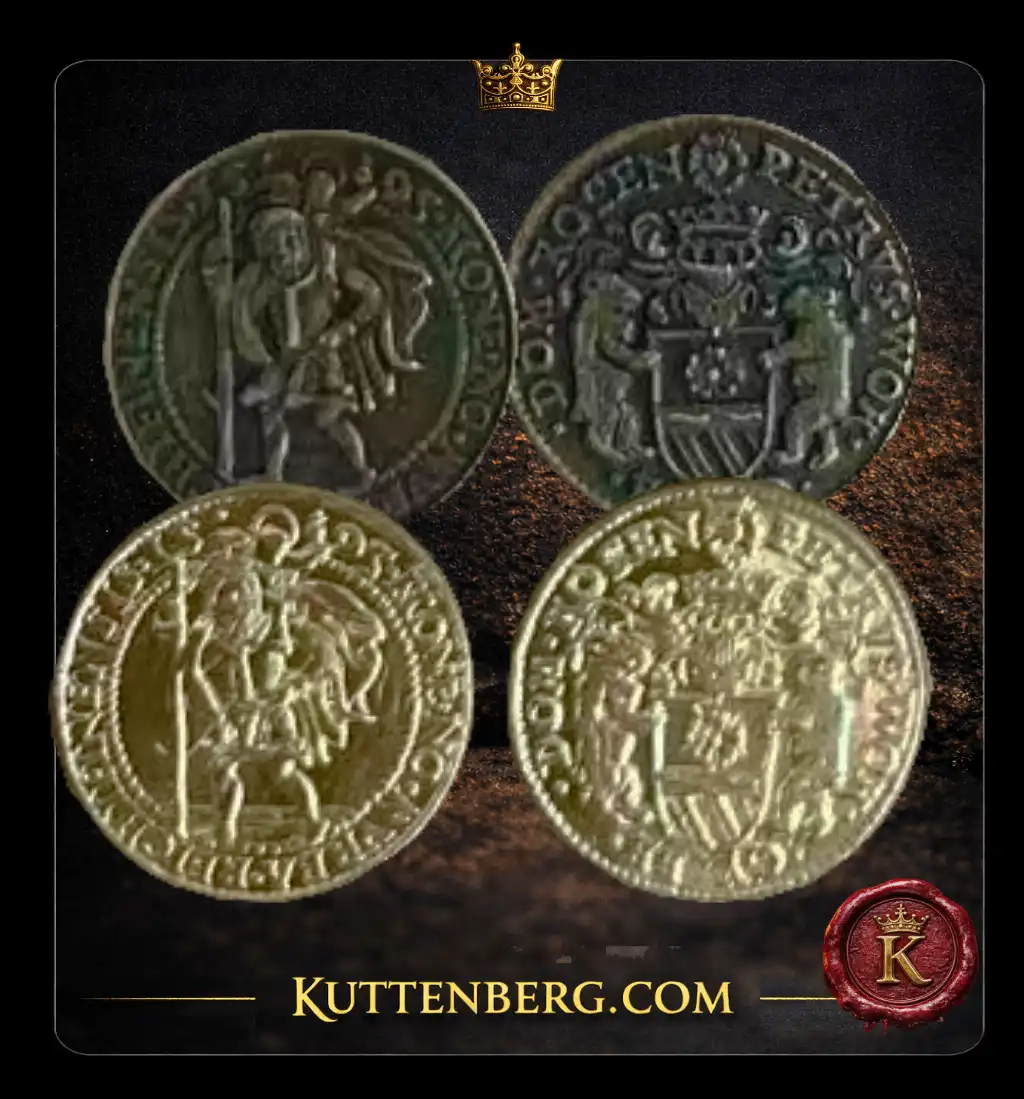
Ducat of Petr Vok of Rosenberg, 1595
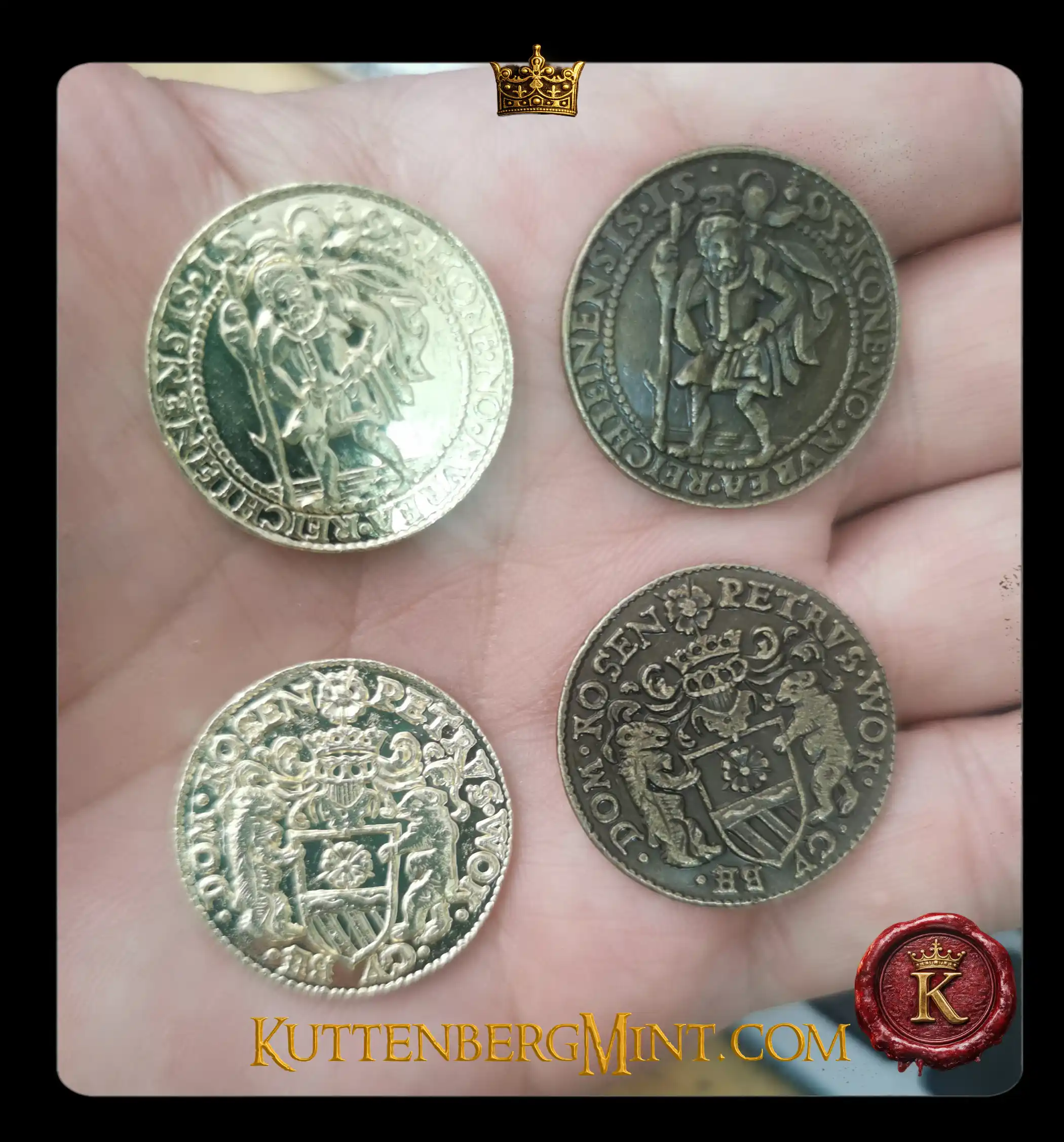
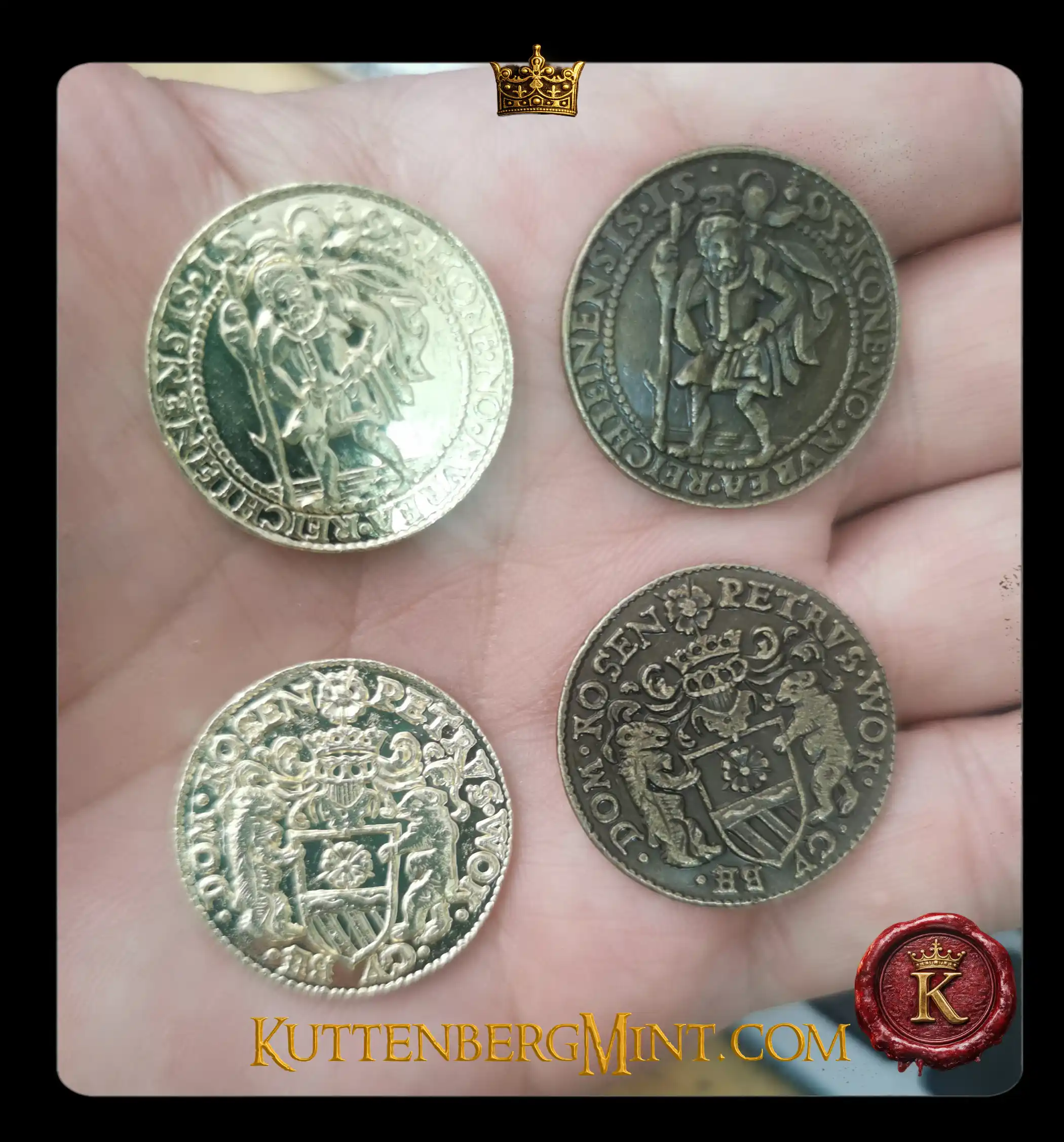
Replica of a rare gold coin of the last ruler of the Rosenberg house. The original was minted in Rychleby, Silesia, today’s Złotý Stok. On one side stands Saint Christopher, the protector of pilgrims and travelers, on the other the crowned Rosenberg coat of arms with two bears, reminiscent of the legendary kinship of the Rosenbergs with the Roman Orsini family.
Our replica was created with great emphasis on historical details and faithfully captures the appearance of the original Renaissance coin.
Coin specifications
* Diameter: 27 mm
* Material: zinc alloy (zamak)
* Variants: Gold / Old gold
* Style: historical replica of a Renaissance coin
* Suitable for: LARP, RPG, reconstruction, collectors
Who is the Ducat of Petr Vok of Rožmberk intended for?
The Ducat of Petr Vok is ideal for:
* Players of LARP, RPG and board games
* Game masters and event organizers
* Historical festivals and historical markets
* Reenactors and living history enthusiasts
* Collectors of medieval coins
* Fans of not only the Czech Renaissance
Ducat of Petr Vok of Rožmberk
A replica of the rare gold ducat of Petr Vok of Rosenberg, the last male representative of one of the most powerful Czech noble families.
The original coin was minted in 1595 at the Silesian mint in Rychleby, today’s Złotý Stok. On one side, it bears the figure of Saint Christopher carrying the baby Christ across the river. The saint was the protector of pilgrims, merchants and all those who set out on a dangerous journey.
The other side is filled with the crowned Orsinian-Rosenberg coat of arms with two bear shield bearers and the Rosenberg rose. The bears are reminiscent of a Renaissance family legend according to which the Rosenbergs were descended from the famous Roman family of the Orsini.
The Latin copy identifies Peter Vok as the ruler of the Rosenberg house, while the other side names the coin as the “new gold coin of Rychleb”. The original ducat weighed approximately 3.5 grams and had a diameter of around 22 millimeters.
The mintage was established shortly after Peter Vok took over the rule of the extensive but indebted Rosenberg dominion after the death of his brother William. It is not only a means of payment, but also a small statement of the family power, origin and prestige of the last Rosenberg.
Although the right to mint coins belonged to the monarch, the powerful Rosenbergs had an exceptional family minting privilege. Petr Vok was therefore able to issue his own ducats with his name and coat of arms at the Rychleb mint – not as a counterfeiter of royal money, but as one of the few Czech nobles who were explicitly granted the right to mint their own coins.
Petr Vok’s ducat shows how close the most powerful Czech nobleman could be to the monarch: he bore his own name, title and family crest on the gold coin. It was not a rebellion against the royal mint monopoly, but a demonstrative use of a privilege that was held by only a few of the most important families.
What’s on the coin
The side with Saint Christopher
On one side is Saint Christopher, who carries the infant Christ across the water. He holds a powerful staff in his right hand.
This is not just a general religious motif. Christopher was considered the protector of:
- travelers and pilgrims,
- people overcoming dangers,
- from sudden death,
- and in a broader sense also of those who transport valuable cargo.
On the gold coin, the motif acted almost as a protective sign. The ducat was intended for long-distance circulation and could pass through the hands of merchants, soldiers and travelers across Europe.
The description reads approximately:
MONE·NO·AVREA·REICHTEINENSIS·15·95
In expanded form:
Moneta nova aurea Reichtenensis
thus:
New gold coin of Rychleby.
“Reichenstein” is the German name of today’s Złoty Stok, traditionally Rychleby in Czech. The year 1595 is divided on the sides of the upper part of the image of the saint.
Side with the Rosenberg coat of arms
On the other side is the complex Orsinian-Rosenberg coat of arms, crowned with a helmet and accompanied by two bears as shield bearers. Above the For example, the Rosenberg rose.
The bears are not accidental. In the Renaissance, the Rosenbergs claimed a supposed kinship with the ancient Roman family Orsini. The Latin ursus means bear, and therefore bears became part of the widespread Rosenberg heraldry. It was not a historically true genealogy, but a very effective family representation: through it the Rosenbergs styled themselves as relatives of one of the most famous Italian princely families.
The description is given as:
PETRVS·WOK·VRS·GVB·DOM·ROSENBERGICÆ
It can be developed approximately as:
Petrus Wok Ursinus, Gubernator, Dominus Rosenbergicae
so loosely:
Petr Vok Ursini, ruler and lord of the Rosenberg house.
The word VRS / Ursinus refers precisely to the alleged Orsinian origin. It is therefore not just the name of the owner of the coin; the entire transcript is a short political and family program.
Why a Czech nobleman minted a coin in Silesia
In the Kingdom of Bohemia, the right to mint coins was essentially a sovereign privilege. Private noble coins were exceptional and were only created under specific legal and property circumstances. This is precisely why the family minting of the Rožmberks is so remarkable.
Petr Vok therefore minted his ducat not in Český Krumlov or Třeboň, but in Rychleby in Silesia, where there was a mint connected to local gold mining. The coin thus refers not only to the person of Petr Vok, but also directly to the place of its origin: the “new gold coin of Rychleb”.
The ducat of the last Rosenberg was not minted in southern Bohemia, but in a mining town on the Silesian border, whose German name Reichenstein – Rich Stone – referred to the local gold deposits.
He did not circumvent the royal minting monopoly by minting the coin in Silesia. The Rosenbergs had their own minting rights granted by the monarch: they obtained them in 1422 from Sigismund of Luxembourg and they had them renewed in 1532. Petr Vok therefore minted legally in Rychleby on the basis of an old family privilege.
However, Silesia was exceptionally suitable for such minting:
- Rychleby was part of the Rosenberg possessions,
- there were gold mines and an established mining and minting infrastructure there,
- Silesia traditionally had a more diverse and decentralized minting than Bohemia itself,
- and the coin was explicitly issued as Rychlebská, not as a Bohemian royal coin.
So rather than a legal loophole, it was the exercise of a legitimate privilege in a place where the family had its own source of metal and the practical possibility of operating a mint. The fact that he did not mint it in Krumlov may have been less provocative towards the monarch, but the legal basis was not the Silesian location — it was the Rosenberg coinage law.
Who was Petr Vok
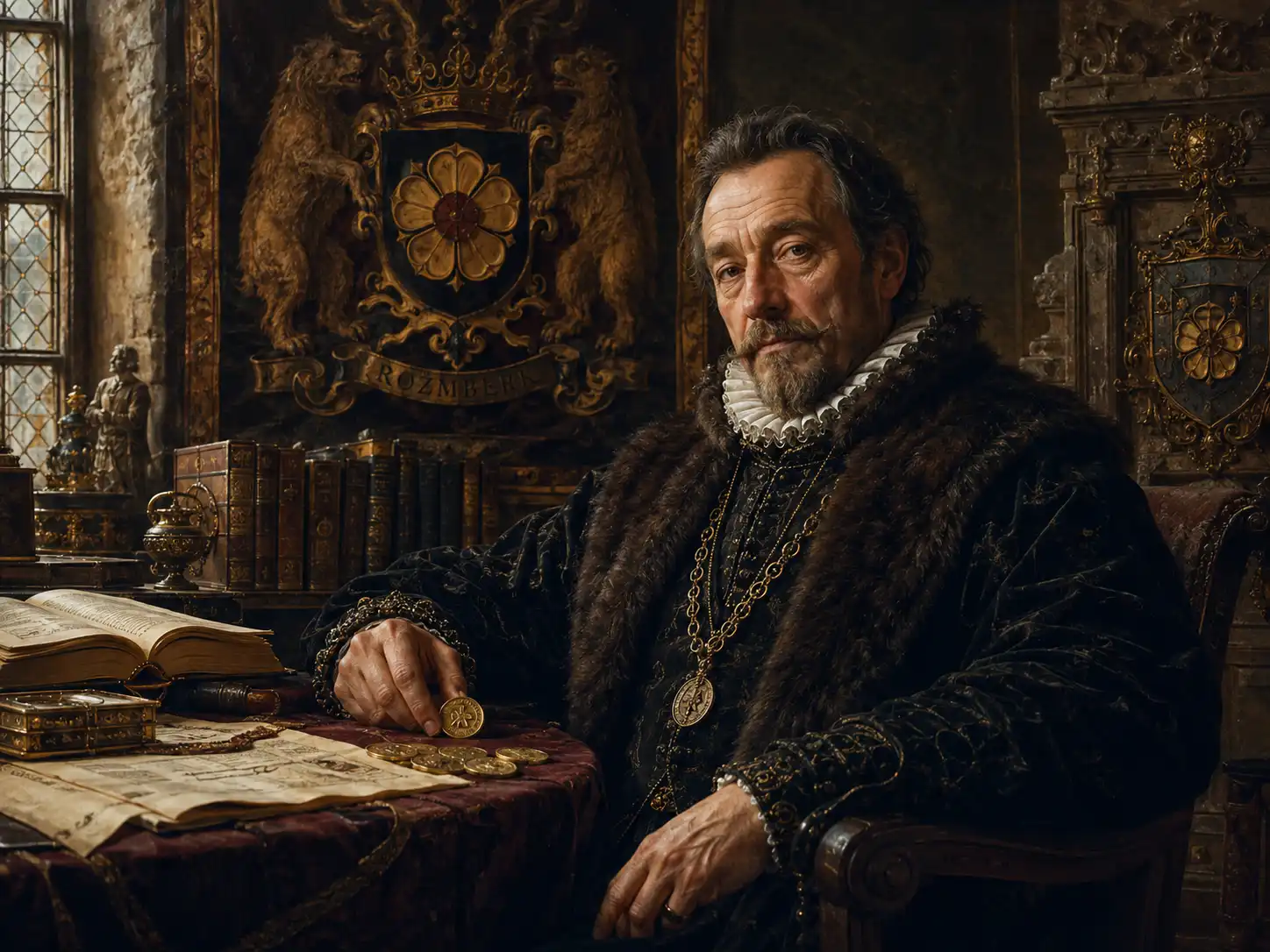
Petr Vok of Rosenberg lived from 1539–1611. After the death of his older brother William in 1592, he took over the rule of the Rosenberg dominion and became the last male member of the family.
His image is more interesting than the popular idea of a cheerful Renaissance nobleman:
- he was an educated aristocrat and an extensive book collector,
- he was one of the important representatives of the Czech non-Catholic estates,
- he inherited an exceptionally large, but also heavily indebted property,
- he had to gradually sell parts of the Rosenberg dominion,
- he died without descendants in 1611 in Třeboň.
He is buried in the Rosenberg tomb in Vyšehrod monastery. The Czech National Bank characterizes him as the last representative of one of the most important Czech noble families.
The year of minting is important: 1595, just three years after the death of William of Rosenberg. The coin was therefore minted at a time when Peter the Great had just taken over the family and needed to publicly demonstrate his new authority. This is partly an interpretation, but the iconography and titulature correspond very well to such a reading.
Original ducat
Historical catalogues list several variants of Petr Vok’s ducats from 1593–1595, and possibly also mintages associated with 1596. They differ, for example, in the shape of the coat of arms, the orientation of the bears, or small elements within the emblem. In the 1595 variant, there are versions with and without a small snake in the emblem.
Basic parameters of the original:
| Property | Historical original |
|---|---|
| Nominal | 1 ducat |
| Year | 1595 |
| Metal | gold |
| Weight | approximately 3.5 g |
| Diameter | approximately 22 mm |
| Rychleby / Reichenstein, today Złoty Stok | |
| Publisher | Petr Vok of Rosenberg |
| St. Christopher and the Orsini-Rozenberg coat of arms |
Preserved specimens are very rare today. Pieces of this variant can be found, for example, in the collections of the National Museum in Prague, the Kunsthistorisches Museum in Vienna and other European institutions.
Basic parameters of our replica:
| Property | Replica |
|---|---|
| Material | Zamac (zinc alloy) |
| Color | gold, gold patina |
| Weight | approximately 4.5 g |
| Diameter | approximately 27 mm |
Shipping & Delivery
We ship worldwide from Prague (EU).
📦 Shipping cost
Shipping is fixed based on destination.
Because shipping cost is fixed, larger orders offer significantly better value.
🌍 Customs & duties
Orders within the EU are shipped without customs fees.
Shipping to the USA
We ship to the USA via our US partner. Your order is processed locally, no customs, no extra fee, you receive it as a domestic USPS shipment.
All customs handling is taken care of on our side — you won’t need to deal with any customs fees or import procedures.
Canada: No import duties. Local taxes may apply depending on your region.
For other non-EU countries (e.g. UK, Switzerland, Norway), customs charges may apply. We list the goods as “toy parts – metal token for games”, many countries have zero customs duties on them, but we do not guarantee what your customs office will decide.
🚚 Delivery time
Europe: 3–7 business days
USA: 10–14 days
Other countries: varies depending on location
📬 Shipping method
We use trusted carriers (Packeta, DHL, Hermes, Colissimo, GLS, UPS, USPS and other partners by country).
Tracking is provided for all orders.
💡 Tip
Because the real shipping costs are the same for 10 or 100 coins, it is advantageous to order more at once.
Most customers order 30–100 coins to make the most of shipping.
The last treasure of the Rosenbergs
At the beginning of 1611, Petr Vok had only a few months left to live.
He once managed one of the largest estates in the Czech Kingdom. The Rožmberks owned towns, castles, ponds, mines and forests stretching across a large part of southern Bohemia. Their court rivaled the court of the king himself in splendor, and Petr Vok bore his own name, coat of arms and title of ruler of the Rožmberk house on gold coins.
But power and wealth are not the same thing.
Peter’s older brother, William of Rožmberk, left the family estates burdened with huge debts. Therefore, Petr Vok gradually sold the estates that his ancestors had accumulated over centuries. In 1601, he even sold Český Krumlov, the old seat of the family, to Emperor Rudolf II and left for Třeboň. The Rosenberg estate was shrinking, but something still remained in the cellars that represented the last real wealth of the family: the family silver treasure.
Then came the Passau family.
It was an army hired by Archduke Leopold of Passau. The soldiers were not paid, so they began to take what they needed themselves. They invaded southern Bohemia, occupied České Budějovice and Český Krumlov, plundered villages and threatened to attack Třeboň. According to contemporary reports, they even threatened to break the dam of the Rožmberk pond, whose water would devastate a large area.
They eventually continued to Prague. There, they tried to take control of the city and unleashed bloody battles and looting. But their biggest problem remained the same reason that brought them to Bohemia: nobody paid them.
A furious army without pay was more dangerous than an enemy on the battlefield. The soldiers could break up into smaller groups and begin systematically plundering the country. Petr Vok therefore came to a solution that must have been almost unimaginable to him.
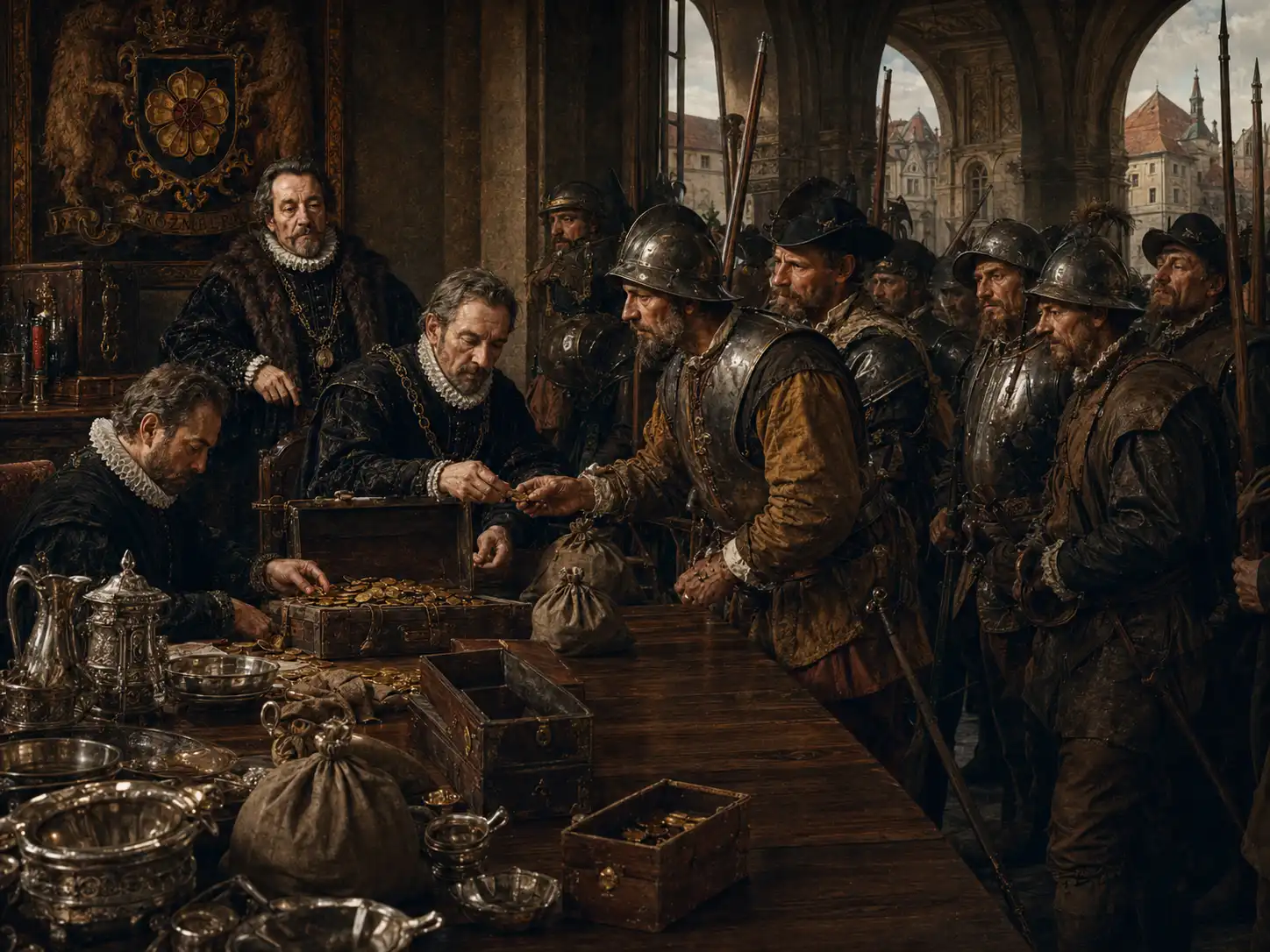
He had the Rosenberg treasuries opened.
Silver cups, bowls, kettles and other objects that had been a reminder of the family’s wealth and glory for generations ceased to be family heirlooms. They were valued, sold off or melted down and turned into money intended to pay the Passau army. It is traditionally stated that Petr Vok provided approximately 100,000 gulden, i.e. about half of the amount needed to satisfy the soldiers.
It was not a business from which he could make a profit. He was not buying more estates or political influence. He was only buying the departure of the army.
There is a peculiar irony in this. In 1595, Petr Vok had his own gold ducats minted. On one side, they bore his coat of arms, the bear shield bearer, and the Rosenberg rose. They were a confident declaration of the power of one of the most important Czech families.
Sixteen years later, the last Rosenberg was no longer using his wealth to glorify the family. He sacrificed the last large part of it to prevent further destruction of the country.
The Passau family eventually left. Petr Vok survived them by only a few months. He died in November 1611 at the Třeboň Castle, and with his death the Rožmberks died out by the sword.
They left behind castles, ponds, roses in the coats of arms of South Bohemian towns — and also coins.
The ducat of Petr Vok therefore not only commemorates the immense wealth of the last Rožmberk. It also commemorates the moment when it became clear what wealth really is worth: not when it is displayed in a treasury, but when a person is willing to give it up.
.
Design
Specifications
Usage
FAQ
Je duIs the Petr Vok of Rosenberg’s crypt double-sided?
Yes, just like the historical original.
On one side is Saint Christopher carrying the baby Christ across the river. On the other side is a richly decorated Rosenberg coat of arms with a crown, Rosenberg rose and two bear shield bearers.
Is it an exact replica of the original?
Yes.
The design is based on the real gold ducat of Petr Vok of Rosenberg, minted in 1595 in Rychleby, Silesia.
The coin’s design and Latin inscriptions were reconstructed from preserved historical specimens. The dimensions correspond to a small but very valuable gold coin of the late Renaissance.
Who was Petr Vok of Rožmberk?
Petr Vok was the last male representative of the famous Rožmberk family.
After the death of his brother William, he took over the rule of the extensive Rožmberk dominion in 1592. He was an educated Renaissance aristocrat, a book collector and one of the important representatives of the Czech non-Catholic estates.
He died in 1611 without descendants and with his death the Rosenberg family became extinct.
Why is Saint Christopher on the coin?
Saint Christopher was the traditional protector of travelers, pilgrims and people embarking on a dangerous journey.
According to legend, he carried a child across a flooded river, who later appeared to him as Christ. That is why he is depicted on the coin with a small Christ on his shoulder and a powerful staff in his hand.
On the ducat, which could travel among merchants, soldiers and nobles across Europe, this motif also had the meaning of a protective sign.
Why are there two bears next to the coat of arms?
The bears refer to the Rosenberg family legend.
In the Renaissance, the Rožmberks claimed an alleged kinship with the ancient Roman family of the Orsini. The name Orsini was associated with the Latin word ursus, meaning bear.
Bears therefore appeared as shield bearers on the extended Rosenberg coat of arms, emphasizing the nobility and supposed ancient origins of the family.
What does the Rosenberg rose mean?
The five-petaled rose was the coat of arms of the Vítkovci and their individual family branches.
The Rožmberks used a red five-petaled rose on a silver field. It is still one of the most famous symbols of Czech aristocratic history and South Bohemia.
On the coin, the rose is not only a family symbol, but also a strong statement of the power and identity of its issuer.
Where was the original ducat minted?
In Rychleby in Silesia, today’s Polish town of Złoty Stok.
The town was known for gold mining and its German name Reichenstein also appears in the Latin copy of the coin.
Petr Vok used the Rosenberg coinage law and local mining and minting background.
What does the Latin inscription on the coin mean?
The inscription on the side with Saint Christopher indicates the mintage approximately as:
New gold coin from Rychleb.
The inscription around the coat of arms states the name and title of Petr Vok as the ruler of the Rosenberg house.
The title also includes a reference to the alleged kinship of the Rosenbergs with the Roman family Orsini.
What was the weight of the historical original?
Approximately 3.5 grams of gold.
This corresponded to the European ducat standard, which was used for centuries as a trusted gold coin for trade, storage of wealth, and important payments.
What is the weight of the replica?
Approximately 4.5 grams.
Although it is not made of gold, the dimensions and relief preserve the character of a small but very valuable Renaissance coin.
What does the coin feel like?
The Petr Vok ducat is smaller than large silver groschen or thalers.
However, thanks to the high relief, dense heraldic design and distinctive motif of Saint Christopher, it appears detailed and representative. It fits well in a purse, collection or as part of a noble treasure.
Is the coin suitable for LARP?
Yes.
The Petr Vok Ducat is great as:
a reward for a Bohemian or Silesian nobleman,
the contents of a family treasury,
payment for rare goods,
a gift to a pilgrim before his journey,
an officer’s salary,
or a valuable coin found in a Renaissance treasure.
Do coins fit into a fantasy world?
Yes.
A holy protector of the road, a crowned coat of arms, bear shield bearers, and intricate Renaissance drawing work very well in a fantasy setting.
A coin can represent the gold of an old noble family, a temple gift, a pilgrim’s talisman, or the currency of a powerful principality.
Can it be used in LARP combat?
Technically yes.
However, Petr Vok probably did not gain his political position by throwing ducats at his opponents.
Historically and in game terms, it is more suitable as a rare currency, reward or part of a treasure.
Is it a replica or fiction?
This is a a historical replica inspired by the real ducat of Petr Vok of Rosenberg from 1595.
The motif of Saint Christopher, the Rosenberg coat of arms, bear shield bearers, Latin inscriptions and the year are based on the historical coin.
Can the coin be used as a gift?
Definitely.
It is especially suitable for lovers of Czech history, South Bohemia, the Rosenbergs, heraldry, numismatics, reenactment and historical games.
It can also be a symbolic a gift for travelers, as Saint Christopher was the traditional protector of people on the move.
Is the coin magnetic?
No.
How long does the surface coating last?
Very long in normal use.
The coin was designed to withstand being carried in a purse, displayed in a collection, and used during games. However, just like real coins, its surface can gradually change naturally with intensive use.
Is the Petr Vok ducat suitable for the game economy?
Yes.
However, it should represent a high-value coin.
In the game, it can function as:
a larger noble payment,
a reward for an important task,
a payment for horses or luxury goods,
part of a dowry,
a bribe to a high official,
or the contents of a family or temple treasury.
For ordinary purchases of bread, beer or lodging, smaller silver coins would historically have made more sense.
How much was a ducat worth?
A ducat represented a considerable sum.
Its exact value purchasing power varied according to time and place, but it was certainly not a coin of the everyday market. An ordinary person could use mostly silver and small coins all his life without owning a single gold ducat.
It was the coin of nobles, wealthy merchants, high officials, military leaders and large financial transactions.
Could Petr Vok really mint his own coins?
Yes.
The Rožmberks were among some ika little to the Czech noble families, which had their own minting privilege.
Petr Vok therefore did not mint ducats secretly, even as counterfeits of royal money. He used an extraordinary family law that showed how close the most powerful Rosenbergs were to the position of independent landowners.
Why was the coin minted in Silesia and not in Český Krumlov?
The Rosenbergs owned Rychleby, where gold was mined and the necessary mining and minting facilities existed.
In addition, Silesia had a strong tradition of local princely and estate minting. That is why it was practical to use the Rosenberg coinage right there.
However, it was not a matter of circumventing the law. The legal basis was the Rosenberg privilege, not just the location of the mint outside the borders of Bohemia itself.
Can the coin be used as a real currency or investment?
You can try, but even in Český Krumlov, innkeepers usually no longer accept Rosenberg ducats.
This is a replica intended for games, collecting, reenactment, teaching and historical or fantasy props.
What is a ducat?
The ducat was a European gold coin with a high and long-term stable gold content.
It originally originated in medieval Italy, but gradually spread throughout almost all of Europe. Thanks to its reliable weight and purity, it was accepted far beyond the borders of the country in which it was minted.
During the time of Peter Vok, the ducat represented a prestigious international coin and at the same time an ideal means of representing monarchs, princes and the most powerful noble families.
What makes the Peter Vok ducat exceptional?
It is a gold coin of the last Rosenberg.
It combines the fate of one of the most famous Czech families, the Silesian gold mines, exceptional noble coinage law, the saint protector of the roads and a family legend of origin from the Roman Orsini.
It is not just a historical currency. It is a small statement of power, origin and prestige of a family that for centuries was one of the most important in the Czech Kingdom.
Safety warning
This coin is not a toy.
Not suitable for children under 3 years – there is a risk of swallowing (small parts).
Keep out of reach of small children.
Additional safety recommendations
-
The coin is metal and may be heavier than regular plastic tokens.
-
Do not use as an object to throw or hit.
-
Do not chew or put in mouth.
-
Not suitable for children under 3 years of age without adult supervision.
Coin Maintenance and Cleaning
Routine Cleaning
-
Wipe with a dry or slightly damp soft cloth.
-
If the patina is more pronounced, use a mild soap solution and dry thoroughly again.
-
Do not use abrasives or steel wool — they can damage the surface finish.
What not to do with a coin
-
Do not leave in moisture for long periods of time (this will extend the life of the patina and the surface).
-
Do not expose to aggressive chemicals (cleaning sprays, acids, acetone, nail polish remover).
-
Do not put in the dishwasher — heat and water pressure destroy the surface finish.
-
Do not leave in salt water (corrosive environment).
-
Do not put in pockets with keys — they quickly scratch the surface.
Long-term storage
-
Store in a dry place.
-
Ideally keep in a bag, box or envelope.
We originally created coins for our games (http://cestycasem.cz), Prague Groschen, especially Interregnum 1313 aka Bloody Times http://interregnum.cz
Related products
-
Thaler 1603 – Replica of a Historical Coin
22,50KčSelect options This product has multiple variants. The options may be chosen on the product pagePricing and sales
Quantity Discount (%) Price 1 - 9 — 22,50Kč 10 - 99 22.22% 17,50Kč 100 - 499 38.89% 13,75Kč 500 - 999 50% 11,25Kč 1,000+ 55.56% 10,00Kč -
Solidus Replica Byzantine Coin
18,75KčSelect options This product has multiple variants. The options may be chosen on the product pagePricing and sales
Quantity Discount (%) Price 1 - 9 — 18,75Kč 10 - 99 26.67% 13,75Kč 100 - 499 40% 11,25Kč 500 - 999 49.33% 9,50Kč 1,000+ 53.33% 8,75Kč -
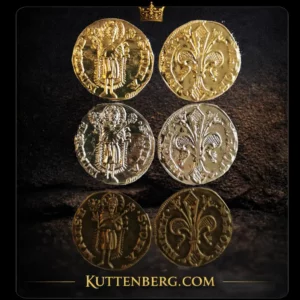
Florin – Medieval Coin Replica for Games
20,00KčSelect options This product has multiple variants. The options may be chosen on the product pagePricing and sales
Quantity Discount (%) Price 1 - 9 — 20,00Kč 10 - 99 25% 15,00Kč 100 - 499 40% 12,00Kč 500 - 999 50% 10,00Kč 1,000+ 53.75% 9,25Kč -
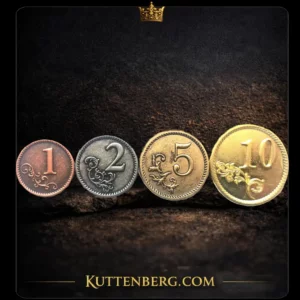
Coins tokens – universal coins for games
Price range: 18,75Kč through 21,25KčSelect options This product has multiple variants. The options may be chosen on the product pagePricing and sales
Quantity Discount (%) Price 1 - 9 — 21,25Kč 10 - 99 23.53% 16,25Kč 100 - 499 38.82% 13,00Kč 500 - 999 52.94% 10,00Kč 1,000+ 54.12% 9,75Kč