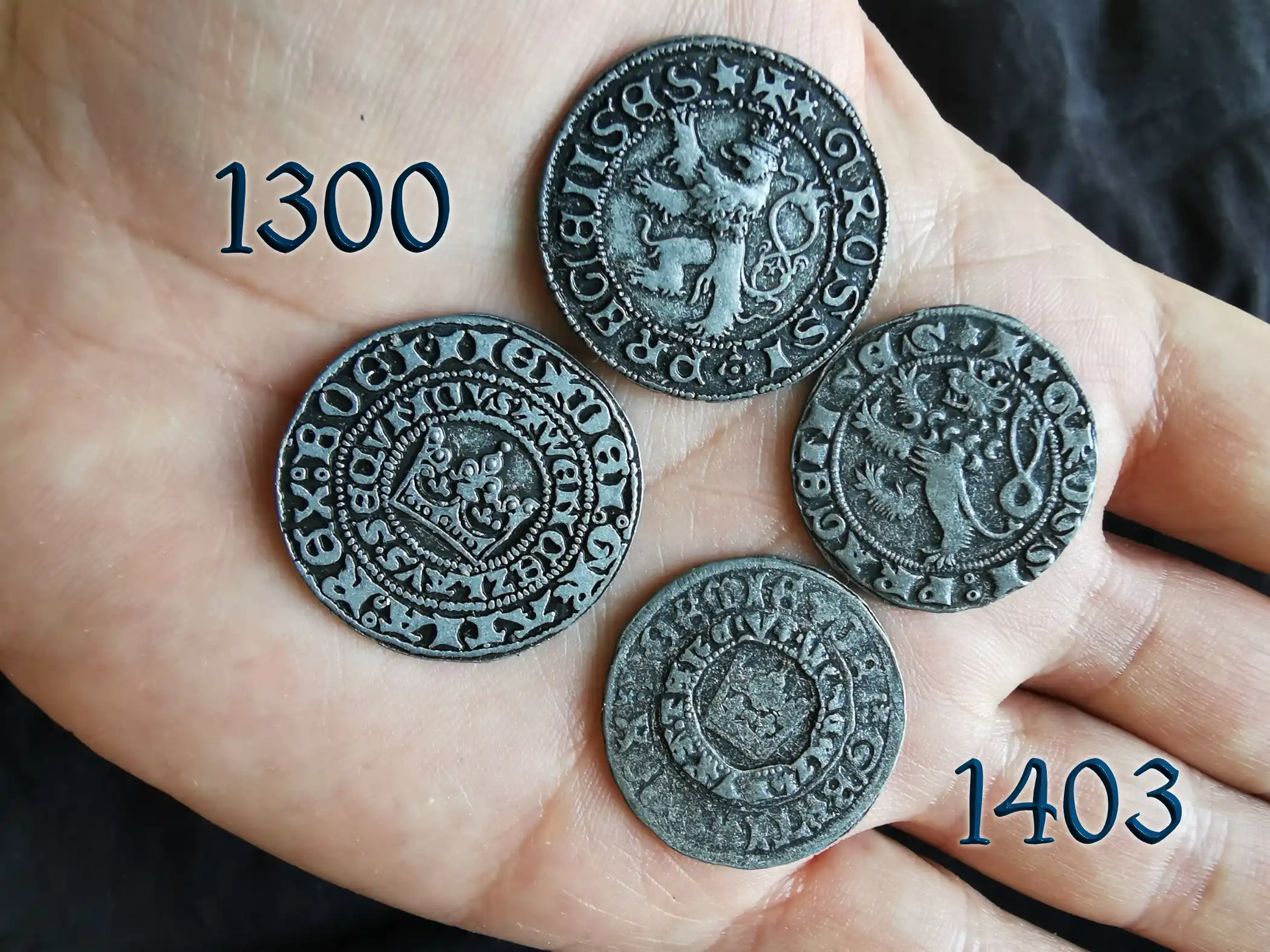
Prague Groschen 1403 – Wenceslas IV.
21,25Kč
Prague Groschen 1403 – Wenceslas IV.
Experience history firsthand. Hold in your hand the coin for which blood was shed at the beginning of the 15th century, which caused the Hussite riots and which was paid by Henry of Skalice in the cult game Kingdom Come: Deliverance.
This authentic metal replica of the Prague Groschen of King Wenceslas IV. will transport your LARP, RPG or board game to the dark and brutal Middle Ages.
Who is the Prague Groschen coin for
It is a game coin for use in board games, cosplay, larps and rpgs, in theater, etc. It will be used, for example, by LARP players, RPG gamemasters, collectors of fantasy items and fans of epic mythology.
Specifications of the Prague Groschen replica
Why buy it
✔ large medieval coin (28 mm)
✔ metal design – no plastic token
✔ ideal as game currency for RPG and LARP
✔ authentic historical inspiration
Uses
tabletop RPG (DnD etc.)
game currency, trophy
atmospheric costume accessory.
LARP and historical events
props for film and theater
collectible fantasy items
Prague Groschen 1403 – Wenceslas IV.
A coin born in times of chaos and heroes
While the groschen of Wenceslas II. were a symbol of unshakable stability, the Prague groschen of Wenceslas IV. (reigned 1378–1419) tells the story of a dramatic transformation of Europe. Due to political unrest and a shortage of silver, the quality of the coins gradually decreased, which paradoxically led to these coins becoming a mass currency for soldiers, mercenaries and Hussite fighters.
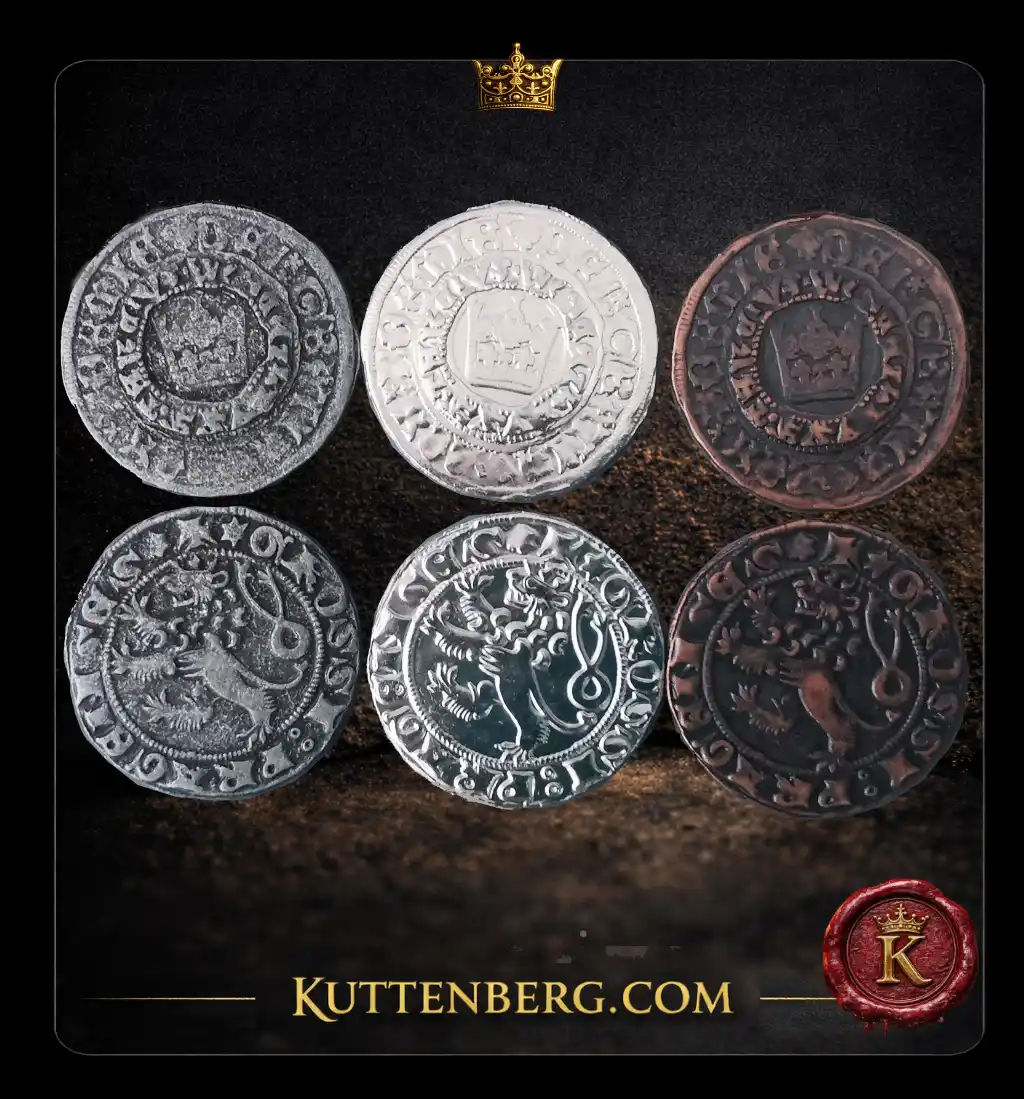
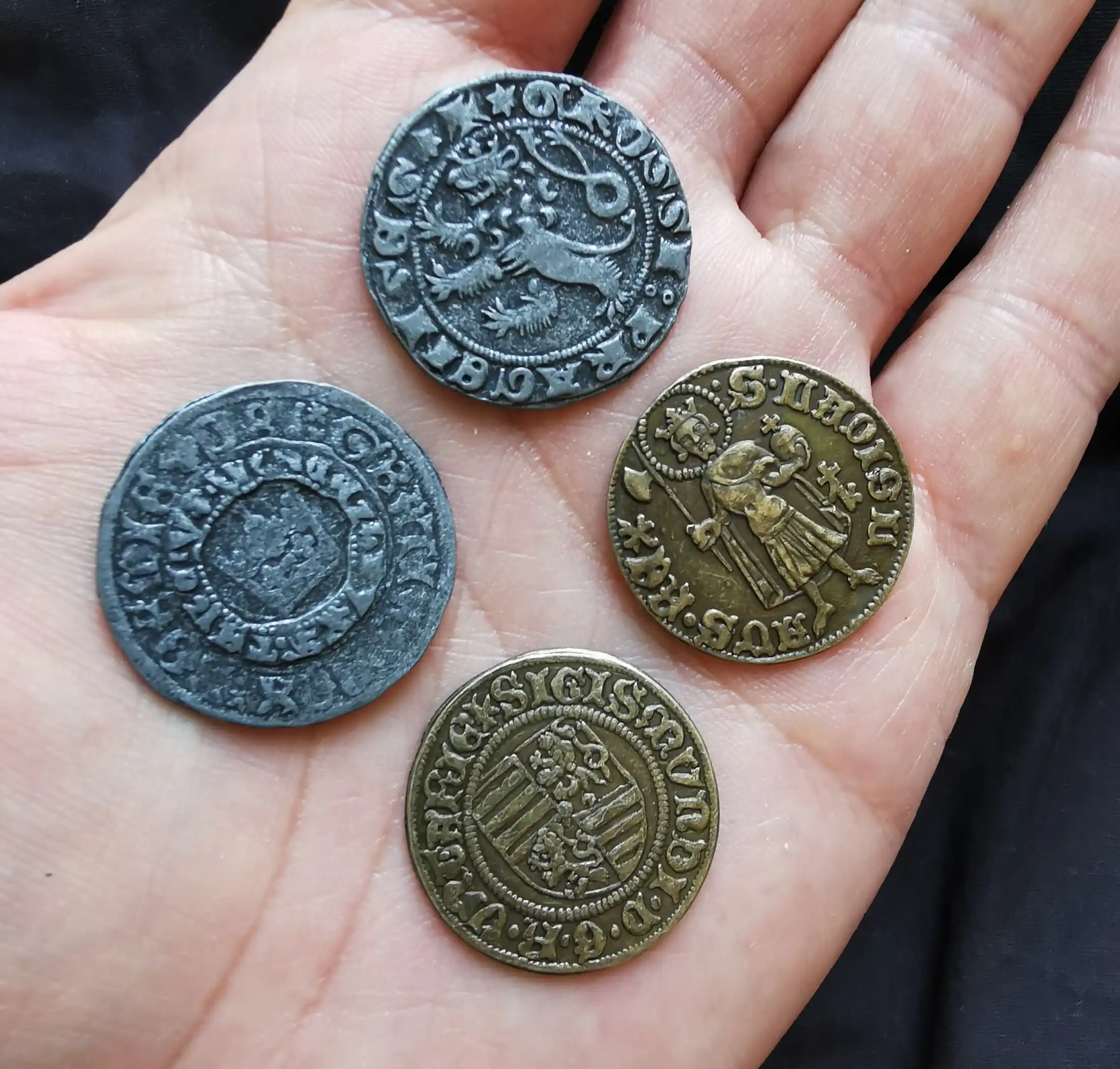
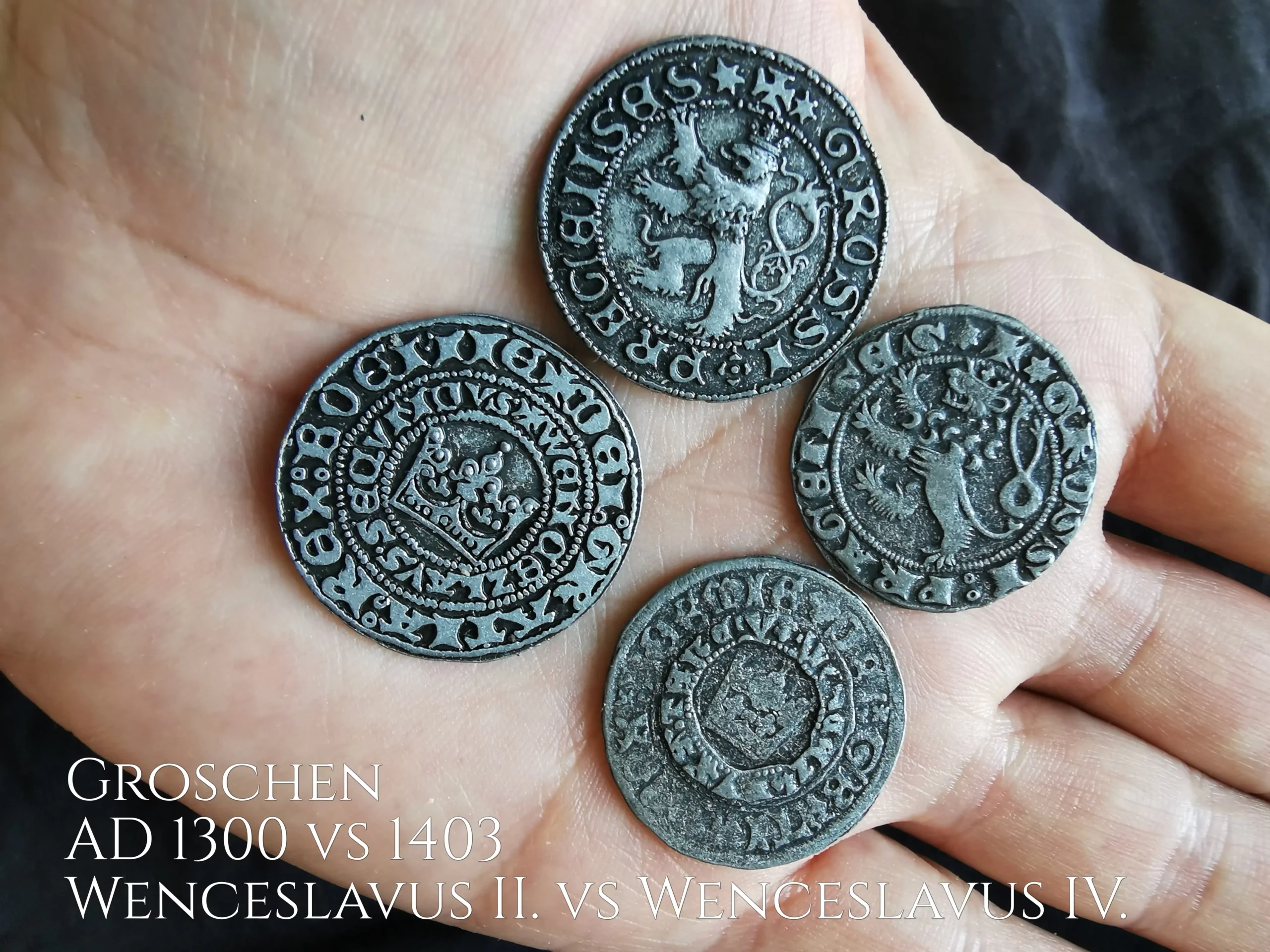
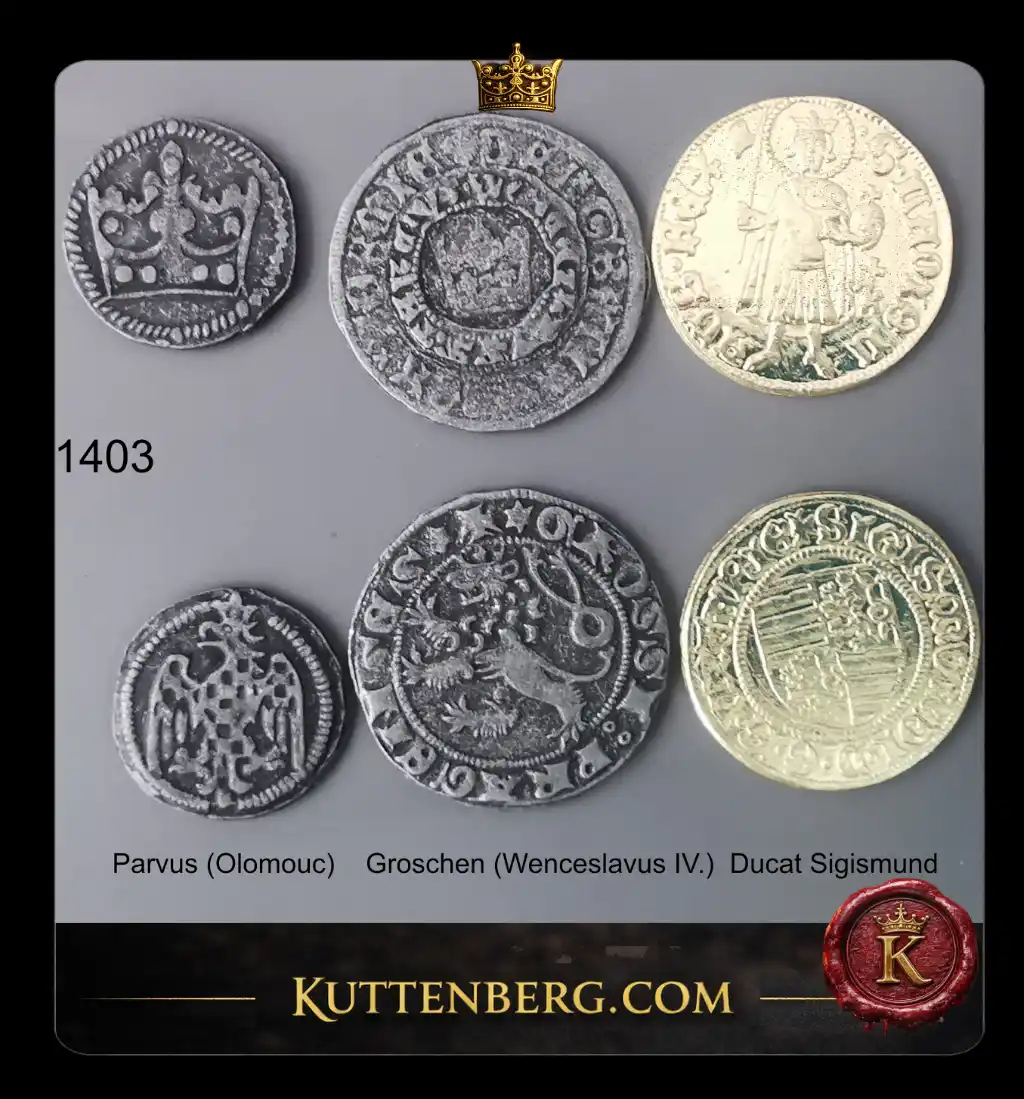
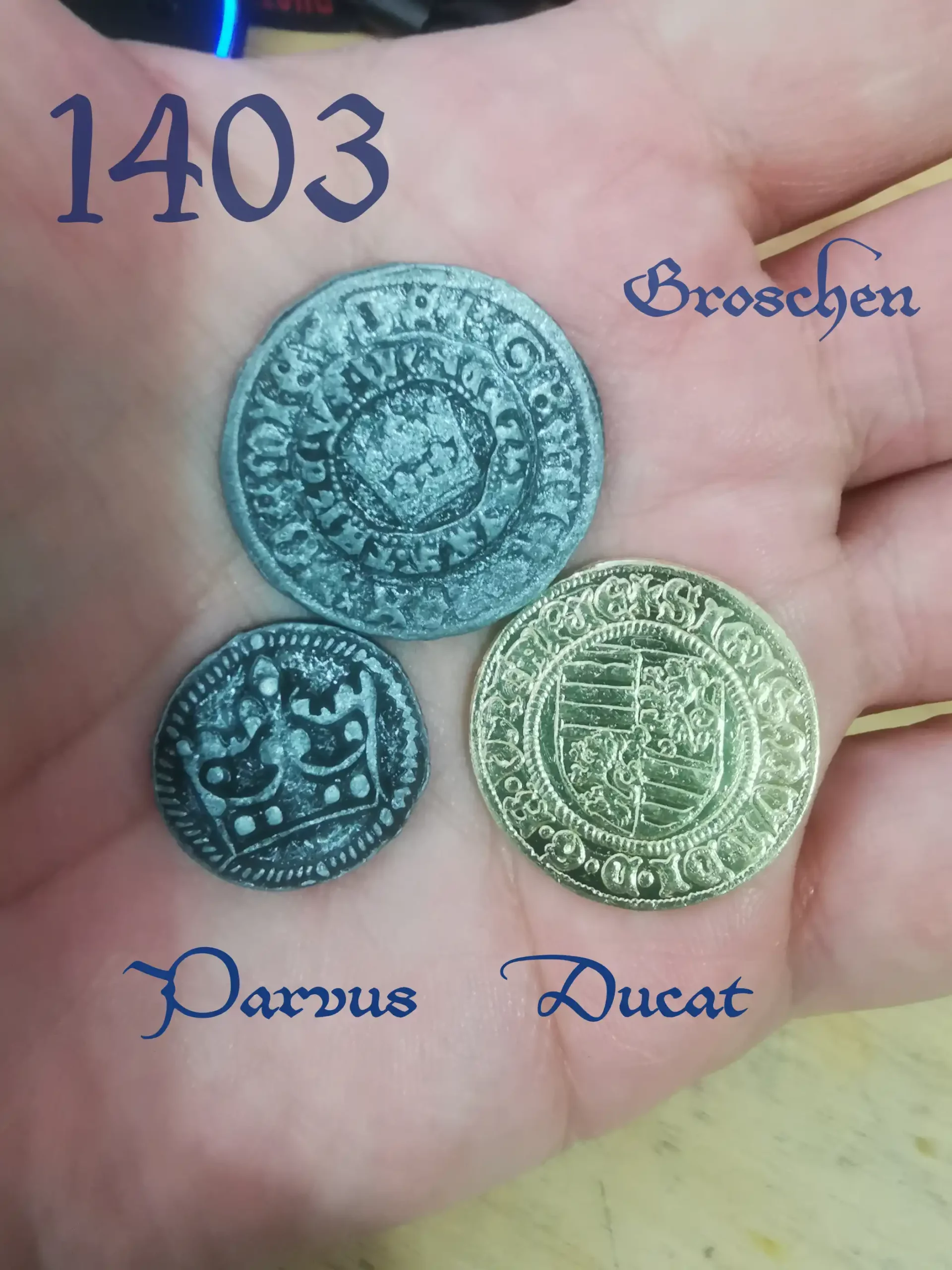
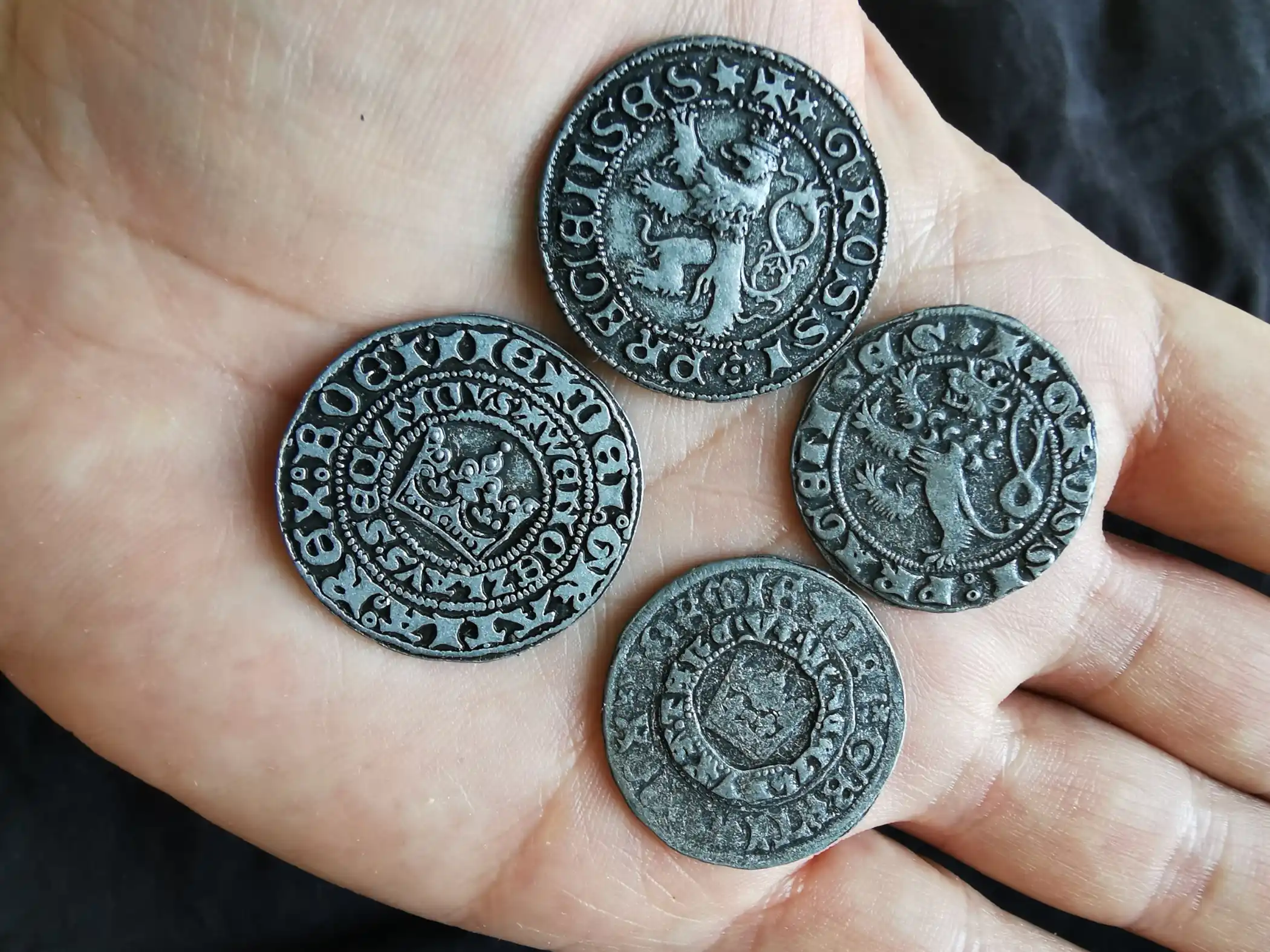
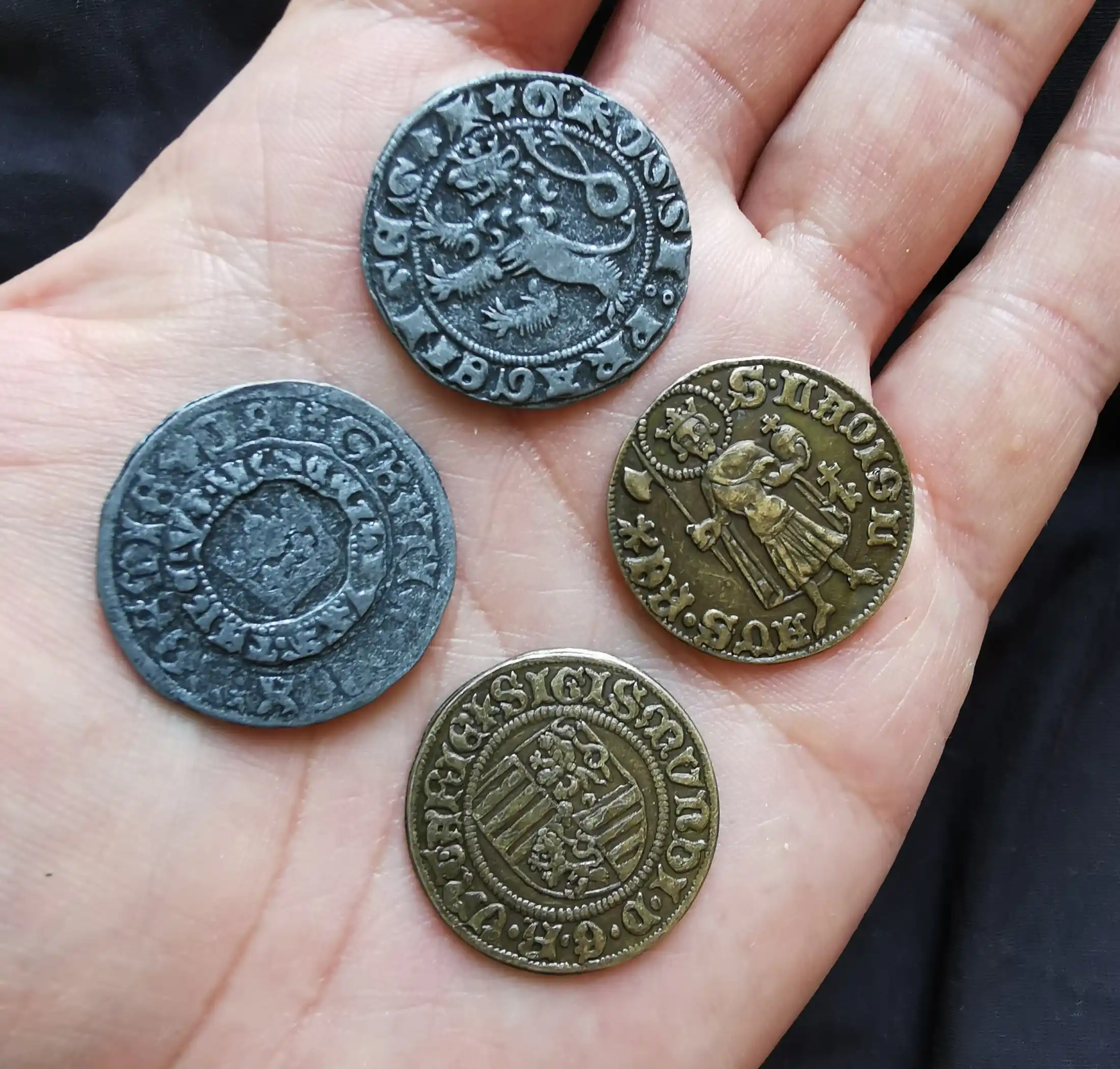
Our replica faithfully captures the specific design of the Wenceslas IV mint. On the obverse (obverse) you will find the typical Czech royal crown with the inscription WENCEZLAUS TERCIUS, on the reverse the iconic Czech lion and the inscription GROSSI PRAGENSES. The coin intentionally bears subtle traces of wear and period imperfections of the minting, which adds to its 100% believability.
WENCEZLAUS TERCIUS?
You may be wondering why the groschen of Wenceslas IV is written WENCEZLAUS TERCIUS and not Quartus. This is an amusing circumstance and is not known even to most Czech history fans. There were 5 successive rulers named Wenceslas (WENCEZLAUS) in Bohemia. The first of them was Prince Wenceslas from the first third of the tenth century, who became a saint and most historians and chroniclers consider him “out of order”. Simply Saint Wenceslas, the patron saint of the Czech land.
King Wenceslas I. ruled in the first half of the 13th century and his grandson Wenceslas II. at the turn of the 13th/14th century. Both were strong, wealthy and successful rulers. Under Wenceslas II. the discovery of the then largest silver deposits in the world took place on the site where the city of Kutná Hora quickly emerged. After Wenceslas II., his son Wenceslas III succeeded. But he ruled for less than a year and was assassinated. Moreover, he was preceded by a reputation as a rather irresponsible fool.
A few years of chaos and civil war followed, which ended with the accession of John of Luxembourg and his wife Eliška Přemyslovna – who was the sister of Wenceslas III. and the daughter of Wenceslas II. The Luxembourgers therefore referred to continuity with Wenceslas II, not his son. Moreover, as a PR it was effective to refer to the powerful, wealthy king who had annexed a number of territories to the crown – and not to his son, who (though through no fault of his own) did not leave a greater mark on history. And so the Luxembourgers simply ignored him completely, as if he had never existed.
So the son of Charles IV. Wenceslas ascended the throne as Wenceslas III. (Yes, on paper there were two different kings with the name Wenceslas III on the Czech throne.) And that’s how he signed himself. His identity as Wenceslas IV was created later by chroniclers. If we wanted to make it a little funnier, we could say that Wenceslas IV was a king who didn’t actually exist.
Who is the Groš of Wenceslas IV for? created?
- LARP and Reenactment: An absolute must for events from the 15th century, the Hussite Wars or the late Middle Ages.
- Kingdom Come fans: An exact replica of the currency that inspired the authors of the KDC game and with which you operate in the game world of Posázaví.
- Board games and RPGs: The perfect metal upgrade for any fantasy or historical game where paper tokens are not enough.
- B2B / Souvenir for castles: An ideal souvenir for monuments associated with the Luxembourg and Hussite eras.
Technical parameters
- Monarch: Wenceslas IV. (1378–1419)
- Historical model: Prague grosz, minted in Kutná Hora (Italian Court)
- Diameter: 27 mm (ideal size for handling in gloves or a purse)
- Material: Highly resistant zinc alloy Zamac
- Surface finishes available:
- Silver (look of a newly minted coin for museums and townspeople)
- Silver patina (patina, ideal for regular larp payments)
- Copper patina (simulation of a worn, then “scammed” grosz with a high content copper)
How do the groschen of Wenceslas II. and Wenceslas IV differ?
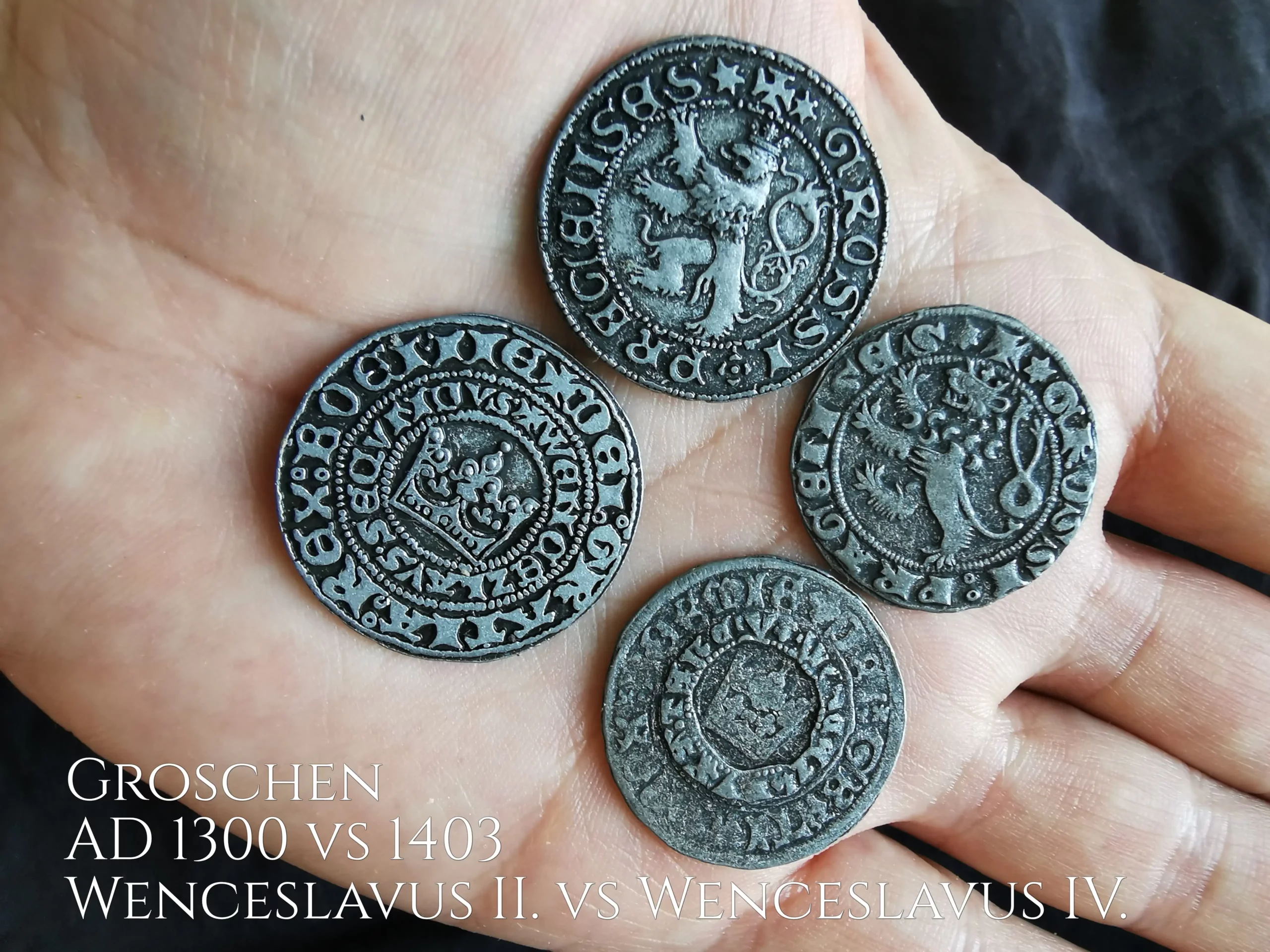
At first glance, we could say that mainly the text inscription WENCEZLAUS SECUNDUS vs WENCEZLAUS TERCIUS. But there were many differences and we supported them in our replicas. The groschen of Wenceslas IV. witnessed wild and dangerous times, and moreover, it was a time when the royal treasury was not doing well. So the king devalued the coin with inflation (as governments still do, after all). The groschen of Wenceslas IV. was a little smaller and its composition was crazy. While Wenceslas II. used mint silver close to 925, Wenceslas IV. had copper added to it, up to a third of the metal content. And the most obvious was the quality of the minting – the groschen of Wenceslas II. are precise, the minting is careful and perfect. The groschen of Wenceslas IV. are sold out. The minting is worn out and faulty. Moreover, the coins were in circulation for a very long time and were changed slowly, so it was typical that they were very worn out and the minting (which would have been worn out anyway) sometimes almost lost its legibility. We used a fairly well-preserved find of a groschen from that time for our replica, but even so, all the aforementioned shortcomings are (intentionally) clearly visible on it. The groschen of Wenceslas II. showed that it was minted by a rich and powerful king. The groschen of Wenceslas IV. shows a country in decay, heading for civil war.
Period authenticity
Today we are used to a currency that changes regularly and older coins quickly disappear from circulation. In the Middle Ages, however, things worked differently.
Coins remained in circulation for decades, and it was quite common for significantly older coins to circulate alongside new mintages. For example, Prague groschen were used from the 14th century until well into the Thirty Years’ War.
Although newer coins often contained less precious metal and gradually became smaller, older, higher-quality coins did not disappear from circulation – on the contrary, they were valued.
In addition, during periods of crisis, such as the Hussite Wars, production was disrupted. The Kutná Hora mint was out of operation for a long time, so it was quite common for coins that were decades old to remain in circulation.
Therefore, it is historically plausible to have a mix of different types of coins and different ages in your game world – exactly as it was in reality.
Shipping & Delivery
We ship worldwide from Prague (EU).
📦 Shipping cost
Shipping is fixed based on destination.
Because shipping cost is fixed, larger orders offer significantly better value.
🌍 Customs & duties
Orders within the EU are shipped without customs fees.
Shipping to the USA
We ship to the USA via our US partner. Your order is processed locally, no customs, no extra fee, you receive it as a domestic USPS shipment.
All customs handling is taken care of on our side — you won’t need to deal with any customs fees or import procedures.
Canada: No import duties. Local taxes may apply depending on your region.
For other non-EU countries (e.g. UK, Switzerland, Norway), customs charges may apply. We list the goods as “toy parts – metal token for games”, many countries have zero customs duties on them, but we do not guarantee what your customs office will decide.
🚚 Delivery time
Europe: 3–7 business days
USA: 10–14 days
Other countries: varies depending on location
📬 Shipping method
We use trusted carriers (Packeta, DHL, Hermes, Colissimo, GLS, UPS, USPS and other partners by country).
Tracking is provided for all orders.
💡 Tip
Because the real shipping costs are the same for 10 or 100 coins, it is advantageous to order more at once.
Most customers order 30–100 coins to make the most of shipping.
The Mercenary’s Purse
Bohemia, summer of the year 1402
The rain drummed on the shingle roof of the Golden Deer inn, turning the path outside the windows into a stream of mud. The pub was dark. Only a few tallow candles struggled with the smoke from the fireplace, and the scent of wet cloaks, beer, and roasted onions wafted between the tables.
Santa Claus moved his tankard closer to him and peered into its dark surface.
“So you’re really leaving?”
The man across from him nodded.
His name was Jan z Křinec, but few people called him that. To most people, he was simply One-Eyed Jan. Years ago, an arrow took his left eye somewhere near the borders of Lusatia, and since then he has worn a leather band over his face.
“I’m leaving.”
“To whom?”
“To Margrave Jošt.”
Nicolas snorted.
“Until yesterday you claimed that Jošt was a traitor.”
“Until yesterday I didn’t have an empty purse.”
That was an answer that was hard to argue against.
The innkeeper walked past them with a pitcher of beer, and somewhere in the corner a group of foremen burst out laughing. Otherwise, it was quiet.
It was getting dark outside the windows.
Mikulas took a leather pouch from his belt and poured its contents onto the table.
A few groschen.
Two smaller silver coins.
And one foreign coin that he had acquired years ago from a German merchant.
Nothing more.
That was all he had.
John looked at the coins.
“How many do you have?”
“Enough for three weeks.”
“Two.”
“Three.”
“You eat too much.”
Micah couldn’t help but smile.
This was their old game.
They argued about everything.
About the prices of horses.
About wine.
About women.
About the king.
About war.
And now they argued about how many days a person could survive on a few groschen.
Jan reached into his purse and put another coin on the table.
Groš.
Freshly minted.
St. Nicholas recognized it immediately.
Kutná Hora.
Silver.
A good coin.
“Is that a deposit?”
“It’s a reminder.”
“What?”
“That loyalty is a beautiful thing. But it won’t satisfy you.”
There was thunder outside.
The innkeeper stoked the fire.
A wet log crackled in the fireplace.
“Do you know what’s strange?” said Jan after a while.
“No.”
“When we were young, we thought that wars were fought by kings.”
“And they don’t?”
“No.”
He pointed to the table.
At the pile of coins.
“They’re fought by these little round things.”
Nicolas was silent.
Because he knew he was right.
Ten years ago he would have given his life for King Wenceslas.
Five years ago too.
Today?
Today he was not sure.
The king was sitting somewhere in the castle.
The gentlemen were arguing.
The Margraves argued.
Everyone claimed that he was fighting for the good of the country.
And yet they all wanted the same thing.
Power.
And money.
While ordinary soldiers stood in the mud and waited to see who would pay them their next paycheck.
“Do you remember Benešov?”
Jan nodded.
How could he forget.
The fortress was burning.
Two days without water.
A third day without food.
And then the messenger came.
He didn’t bring reinforcements.
He didn’t bring orders.
He brought a chest.
A small oak chest full of coins.
And within an hour they were all ready to fight again.
It was that simple.
“See.”
Jan tapped the table.
“They’re not banners.”
Another tap.
“They’re not coats of arms.”
And one more thing.
“They’re coins.”
Santa picked one up.
It was cold.
Heavier than he remembered.
How many times had he held one like that?
A thousand times?
Ten thousand times?
He used them to pay for a night’s stay.
Food.
Shoes.
A new belt.
A doctor.
A grave for a friend.
A ransom.
Beer.
Life.
Death.
In the end, everything always ended with coins.
“And yet you leave.”
Jan nodded.
“Yes.”
“Even though you don’t know if Jošt is right.”
“I don’t know.”
“And you don’t mind?”
One-eyed John thought for a while.
A long time.
So long that Nicholas almost expected some wisdom.
Finally, the former soldier just smiled.
“Do you know what I learned?”
“What?”
“That the dead are usually right.”
“What do you mean?”
“The living argue about it. The dead already know.”
They both laughed.
Too loud.
Maybe because there was more truth to it than they would have liked.
The rain slowly stopped.
The first stars appeared among the clouds outside the windows.
Jan finished his beer.
He got up.
He threw his cloak over his shoulders.
And took his purse in his hand.
The same purse that had traveled with him half a kingdom.
There were only a few coins in it.
And yet it represented his entire future life.
“Well, goodbye.”
“Goodbye.”
“When I come back in a year, you buy the beer.”
“When you come back in a year, I buy the whole barrel.”
Jan smiled.
Then he opened the door.
The cool evening air blew in.
And he disappeared into the darkness.
Santa Claus was left sitting alone.
A few groschen in front of him.
All his possessions.
All his future.
He reached out, poured the coins back into the bag, and held it tightly. he pledged.
In the morning he will have to decide.
Like thousands of other men in the turbulent years of Wenceslas IV’s reign.
Whom to serve.
Whom to trust.
And for whose coins to fight.
Because sometimes the fate of a kingdom is hidden in the crown of a king.
And sometimes in just a few silver groschen at the bottom of an ordinary mercenary’s purse.
The Kutná Hora Merchant’s Month
Kutná Hora, autumn of the year of our Lord 1402
It was warm in the house at the Golden Grosz.
The stove was roaring.
Two wax candles were burning on the table, their light reflecting off the metal scales that lay between the two men.
Not one he did not look like a warrior.
Neither carried a sword.
And yet both knew that dangerous times were coming.
Matthew of Kutná Hora took a groschen in his hand and placed it on the scales.
Then the second.
Then the third.
Carefully.
As always.
Opposite him sat Conrad of Nuremberg, a merchant of fabrics and spices.
“That’s all?”
Matěj nodded.
“For today’s trip, yes.”
Konrád sighed.
“Two years ago, I would have carried three times as much.”
“Two years ago, times were different.”
“That’s what I’m talking about.”
Matěj smiled.
The buyers often complained.
Sometimes with good reason.
Sometimes out of habit.
This time, however, he knew that his friend was right.
A few years ago, the journey between Kutná Hora and Nuremberg was almost boring.
The toll was paid.
The toll was paid. toll.
One gunman was hired.
And one could set off.
Today?
Days it was necessary to hire four.
Sometimes six.
And even that wasn’t enough.
“How much did the protection cost you?”
“Twelve groschen.”
Matěj stopped.
“Twelve?”
“And I bargained.”
“Last year eight.”
“I know.”
“Forearm five.”
“I know too.”
Konrad took a sip of wine.
“People feel something is happening.”
“What?”
“They don’t know.”
“That’s not the answer.”
“But it is.”
The merchant shrugged.
“They don’t know the cause. They only see the consequences.”
Matěj nodded silently.
That made sense.
The farmers at the market knew nothing about the margraves’ disputes.
They knew nothing about the negotiations gentlemen.
They knew nothing about court intrigues.
But they noticed that iron had become more expensive.
That salt cost more.
That the merchant arrived late.
That the other one did not arrive at all.
That was how the common man recognized the approaching unrest.
Not from the chronicles.
From the prices.
Konrad reached into his purse.
He emptied its contents onto the table.
Kutna Hora groschen.
Florins.
A few imperial coins.
Even one Venetian one.
Matěj smiled.
“You must be driving half of Europe.”
“Half of Europe owes me money.”
“And the other half?”
“She wants to rob me.”
They both laughed.
After a while, however, the laughter died down.
A horseman rode past the house outside.
Quickly.
Too fast.
Like someone who carries bad news.
Konrad turned at the sound.
“See?”
“What?”
“This never happened before.”
“What exactly?”
“Hurry up.”
Matěj didn’t understand.
However, Konrád continued.
“When business is good, people travel slowly.”
“That’s a strange thought.”
“But true.”
He smiled.
“A merchant who makes money is in no hurry.”
“And when he doesn’t make money?”
“Then he runs away.”
They were both silent for a while.
Voices could be heard from the street.
Someone was closing up shop.
Someone was loading a truck.
Someone was counting the daily sales.
Just like every evening.
And yet something was different.
“Do you remember Master Ondřej?”
Konrád suddenly asked.
“The salt merchant?”
“Yes.”
“What about him?”
“He sold the warehouse last week.”
“Why?”
“He said he wanted to buy a field.”
Matěj frowned.
“That’s not It makes sense.”
“Exactly.”
They both stared into each other’s eyes for a long time.
They didn’t have to explain anything.
Traders know fear before soldiers.
Because soldiers get orders.
Merchants get the bill.
And the bill never lies.
“So you think there will be a war?”
Konrad shrugged.
“I don’t know.”
“That’s an answer worthy of a priest.”
“No.”
He pointed to the coins between them.
“That’s a merchant’s answer.”
He took a penny and slowly spun it around table.
The coin spun for a moment in the candlelight.
Then it lay down.
Face up.
“You know what’s strange?”
he said.
“Tell me.”
“Kings think they rule the land.”
“And “Are they not in control?”
“Just a little.”
He pointed to the penny.
“This coin travels more cities than most nobles.”
Another showing.
“He hears more languages than most priests.”
And finally he placed it in front of him.
“And he knows the coming problems before most military leaders.”
Matthew smiled.
“That sounds almost like a prayer.”
“That’s not a prayer.”
Konrad finished his wine.
“That’s accounting.”
When he left for the inn an hour later, his purse still weighed the same.
The same number of coins.
The same wealth.
And yet he felt that he was poorer than in the morning.
Because some losses are not counted in pennies.
Sometimes a person loses his confidence.
And when confidence begins to fade, it doesn’t take long for coins to disappear too.
A few months later, King Sigismund’s troops enter the Czech lands.
But that evening no one did not know.
The buyers only felt what merchants have felt since time immemorial:
that the air had changed.
And that the times to come would not be cheap.
The Treasure of the Landlord
Landštejn Castle, Winter of the Year of the Lord 1402
The snow had been falling for the third day.
The courtyard under the tower disappeared under a white blanket, and only the dark tips of the spruces emerged from the forest below the castle.
William of Landštejn stood by the window and looked at the landscape.
Beautiful.
Quiet.
And deceptive.
Because a person could own the entire region and still not be sure that he would own it in a year.
Behind him, the fireplace crackled.
The scribe unrolled the parchment.
“Another report from Prague, sir.”
William did not turn around.
“Read.”
“There is talk of new disputes between the king’s supporters and Margrave Jošt.”
“Again.”
“Yes, sir.”
William sighed.
He had heard dozens of similar reports in recent months.
Each one was a little different.
Each one was a little worse.
“And what about Kutná Hora?”
“The mining continues.”
“That’s good.”
“But the merchants complain about the safety of the roads.”
Vilém nodded.
He already knew that.
He knew it even better than the merchants.
Because the merchants saw the ambush car.
He saw the reason.
In recent years, the country had changed.
Not on the outside.
Castles stood.
Cities prospered.
Churches rang bells.
But underneath it all, something was cracking.
Like ice on a pond in early spring.
At first glance solid.
In reality, ready to break.
He turned away from the window.
A small iron-bound chest stood on the table.
He placed his hand on it.
It was heavy.
There were coins inside.
Not hundreds.
Not thousands.
Just a few dozen of the best.
Ducats.
Florins.
Grosses.
Money he could use at any time.
His real wealth did not lie in a chest.
It lay outside.
In three villages.
In two mills.
In one pond.
In the forest.
In the fields.
In the people.
But that’s exactly why coins were important.
Because you can’t take away the fields.
You can’t take away the forests.
You can’t take a village away.
You can take a coin away.
He opened the chest.
It wasn’t full by any means.
It used to be.
Years ago.
Before he repaired the walls.
Before he settled the border dispute.
Before he paid his sister’s dowry.
Before he helped his cousin.
Before the king asked for extraordinary help.
The scribe asked cautiously:
“Should we answer the Lord of Hradec?”
William smiled.
That was the question that occupied him for weeks.
The Lord of Hradec offered alliance.
Friendship.
Joint action.
At least that’s what he called it.
In reality, he only wanted to know one thing.
Which side would the Landštejns take?
“No.”
“No?”
“Not yet.”
The scribe looked up in surprise.
“Sir, most of the nobility is already making up their minds.”
“That’s why.”
William took one ducat out of the chest.
He placed it on the table.
Next to it was another.
Then a third.
Finally fourth.
“You know what’s strange?”
The scribe shook his head.
“When I was young, I thought a nobleman made decisions based on honor.”
“And today?”
“Today I know that first he must survive.”
Youth is simple.
An enemy is an enemy.
A friend is a friend.
The right thing is obvious.
Then you get old.
And you find that most decisions are not between good and evil.
But between two bad choices.
A honking outside wind.
Somewhere under the castle a dog barked.
“If I sided with the king today and he lost, what would be left for my son?”
The scribe was silent.
“And if I sided with his enemies and they lost?”
Again no answer. William nodded.
Exactly.
That’s why hesitated.
Not out of cowardice.
Out of responsibility.
A mercenary risks his own life.
A merchant owns property.
A master risks the future of people who will be born long after his death.
He closed the chest again.
The metal lid clicked hollowly.
“Write to the gentleman from Hradec.”
“What should I write?”
“That I thank you for his friendship.”
“Yes, sir.”
“And that I will think about the whole thing some more.”
The scribe sighed.
“That will not be a satisfactory answer.”
Willem smiled.
“That’s why it’s right.”
When the scribe left, he was left alone in the hall.
He went back to the window.
The snow was still falling.
As quietly as it had been an hour ago.
As quietly as it had been a hundred years ago.
As quietly as it would fall in a hundred years.
Kings come and go.
Wars begin and end.
Coins change hands.
But the land remains.
And the duty of a good lord is not to win the next battle.
It is to ensure that his family and his people survive the next one.
Identity
Verwenden Sie Silbergroschen als Standardwährung,
Gold für hohe Werte,
patiniertes Silber für Münzen mit niedrigem Wert.
Design
Specifications
Usage
RPG
Brettspiele und andere Spiele
Film- und Theaterrequisiten
Themenmärkte und ähnliche Veranstaltungen
Themen-Kinderlager
FAQ
Is the Prague Grosz coin double-sided?
Yes, all our coins are double-sided. The Prague Grosz has a Czech lion on the obverse, and a royal crown on the reverse, just like the original.
Is it an exact replica of the original?
Yes, it is based on the real appearance of the Prague Grosz. The design is a replica of the coin of Wenceslas II. from the first minting of the groschen shortly after 1300, the size and weight are more or less authentic.
What inscriptions are in the ring of the Prague Groschen?
On the obverse of the Prague Groschen is GROSSI PRAGENSES(Prague Groschen), On the reverse of the Prague Groschen is in the outer ring DEI GRACIA REX BOEMIE(By the grace of God, King of Bohemia) and in the inner ring WENCEZLAVS SECVNDVS. Later mintages of the Prague Grosz differed in the name of the ruler.
What is the weight of one coin?
Approximately 7 grams.
What does the Prague Grosz coin feel like?
Authentic, it is a metal coin.
Can it be used in LARP combat?
Yes, you can throw it with a slingshot. But we recommend it as a means of payment, not as a weapon 🙂
Is the coin suitable for LARP?
Yes, it is made of a durable alloy and has safe rounded edges.
Is it a replica or fiction?
It is a fairly faithful historical replica created in real size
according to a real coin from the time of Wenceslas II.,
Can the coin be used as a gift?
Yes, it is often used as a thematic trifle or collector’s item.
Is the coin magnetic?
No
What is the lifespan of the surface treatment?
It depends on the method of use, in general – the lifespan is long.
Can coin as a real currency or investment?
No — You can try, but we are afraid that you will not succeed, it has been withdrawn from circulation for a few centuries 🙂
This is a replica for games, collecting or as a prop (it is not minted from silver and has no real value as a currency).
Safety warning
This coin is not a toy.
Not suitable for children under 3 years – there is a risk of swallowing (small parts).
Keep out of reach of small children.
Additional safety recommendations
- The coin is metal and may be heavier than regular plastic tokens.
- Do not use as a throwing or striking object.
- Do not chew, do not put in mouth.
- Not suitable for children under 3 years of age without adult supervision.
Coin maintenance and cleaning
Regular cleaning
- Wipe with a dry or slightly damp soft cloth.
- If the patina is more pronounced, use a mild soap solution and dry thoroughly again.
- Do not use abrasives or steel wool — they can damage the surface finish.
What not to do with a coin
- Do not leave in moisture for a long time (this will extend the life of the patina and the surface).
- Do not expose to aggressive chemicals (cleaning sprays, acids, acetone, nail polish remover).
- Do not put in the dishwasher — the heat and pressure of the water destroy the surface treatment.
- Do not leave in salt water (corrosive environment).
- Do not put in pockets with keys — they quickly scratch the surface.
Long-term storage
- Store in a dry place.
- Ideally keep in a bag, box or envelope.
We originally created the coins for our games (http://cestycasem.cz), Prague Groschen, especially Interregnum 1313 aka Bloody Times http://interregnum.cz
You may also like…
-
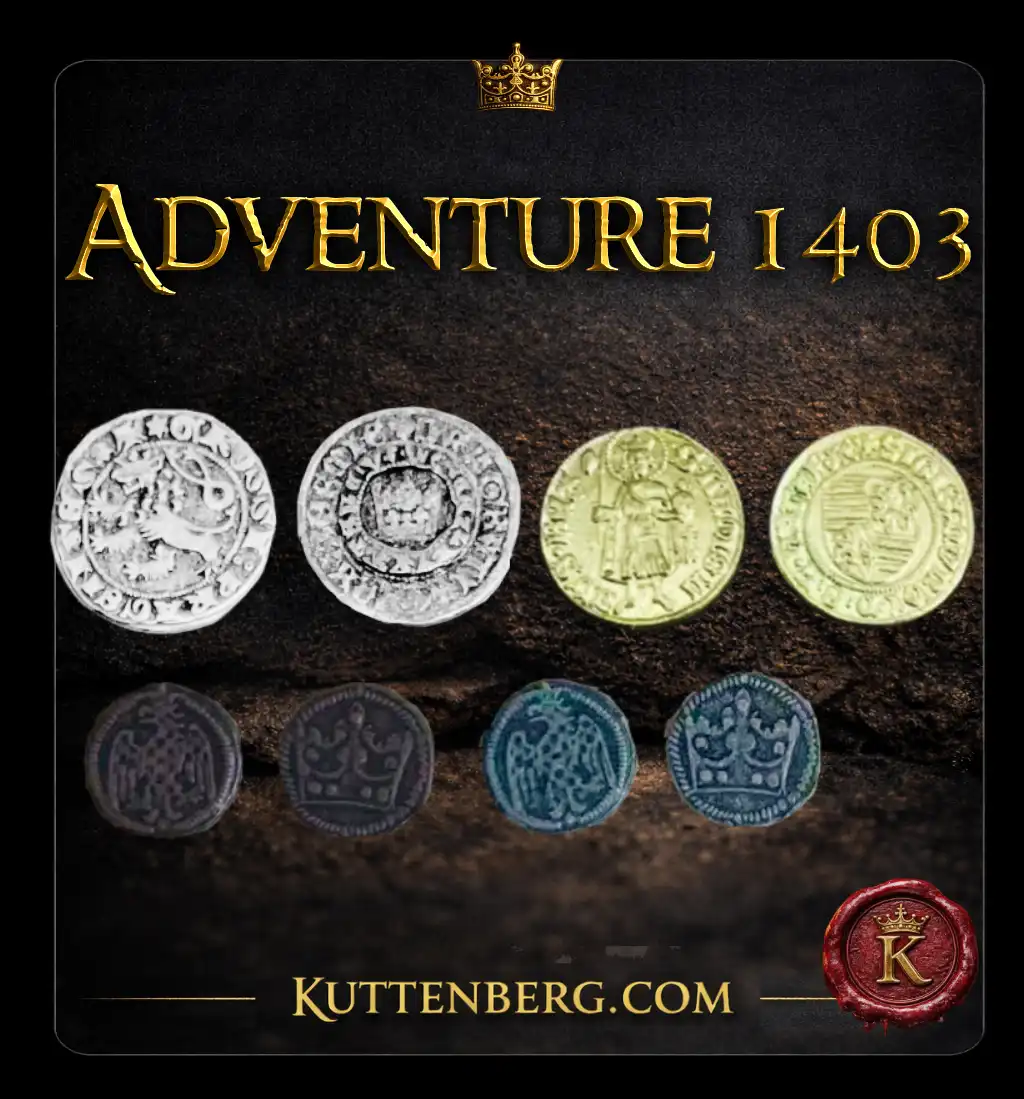
Mince českého království 1403
Price range: 250,00Kč through 9.750,00KčSelect options This product has multiple variants. The options may be chosen on the product page
Related products
-
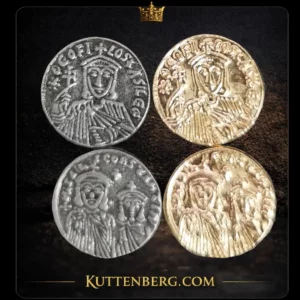
Solidus Replica Byzantine Coin
18,75KčSelect options This product has multiple variants. The options may be chosen on the product pagePricing and sales
Quantity Discount (%) Price 1 - 9 — 18,75Kč 10 - 99 26.67% 13,75Kč 100 - 499 40% 11,25Kč 500 - 999 49.33% 9,50Kč 1,000+ 53.33% 8,75Kč -
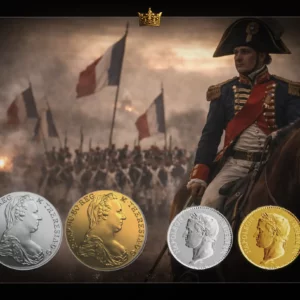
Coins for Napoleonic era Europe Imperiale
Price range: 750,00Kč through 9.250,00KčSelect options This product has multiple variants. The options may be chosen on the product page -
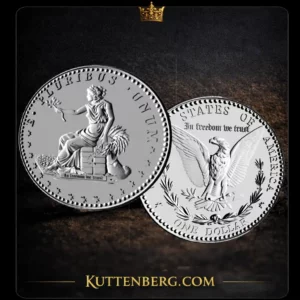
Dollar – Western Dollar – Metal Replica Coin
22,50KčSelect options This product has multiple variants. The options may be chosen on the product pagePricing and sales
Quantity Discount (%) Price 1 - 9 — 22,50Kč 10 - 99 22.22% 17,50Kč 100 - 499 38.89% 13,75Kč 500 - 999 50% 11,25Kč 1,000+ 55.56% 10,00Kč -
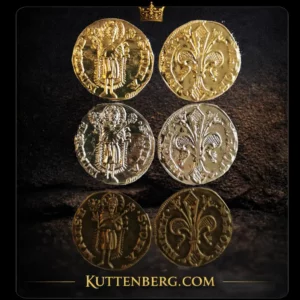
Florin – Medieval Coin Replica for Games
20,00KčSelect options This product has multiple variants. The options may be chosen on the product pagePricing and sales
Quantity Discount (%) Price 1 - 9 — 20,00Kč 10 - 99 25% 15,00Kč 100 - 499 40% 12,00Kč 500 - 999 50% 10,00Kč 1,000+ 53.75% 9,25Kč