Solidus Replica Byzantine Coin
€ 0,75
Solidus
The solidus was one of the most reliable gold coins in history. Introduced under Constantine the Great in the 4th century, it became the backbone of the late Roman and Byzantine economy.
This replica is inspired by solidus coins found in Central Europe, including those linked to Great Moravia.
Small, precise, and made of gold, the solidus represents value in its purest form — a coin that does not need to prove itself.
Parameter Value
Diameter 18 mm
Thickness approx. 2 mm
Weight approx. 2 g
Material Zinc alloy
Color variants Silver, Gold, Silver patina, Copper patina, Verdigris
Suitable for LARP, RPG, board games, gifts, props, etc.
Who is the coin for
It is a game coin for use in board games, cosplay, larp and rpg, in theater, etc. It is a game coin for use in board games, cosplay, larp and rpg, in theater, etc. It will be used, for example, by LARP players, RPG gamemasters, collectors of fantasy items and fans of epic mythology.
Uses of coin
Suitable as a game currency, trophy, collector’s item or atmospheric accessory to a costume.
Solidus Replica Byzantine Coin
Solidus — gold that outlasted empires.
A coin that remained stable while the world around it changed.
The solidus was one of the most reliable gold coins in history. Introduced under Constantine the Great in the 4th century, it became the backbone of the late Roman and Byzantine economy.
For centuries, its weight and gold content remained remarkably stable — a rare achievement in a world where currencies constantly lost value.
Because of that, the solidus was trusted far beyond the borders of the empire.
A coin of continuity
The solidus was not just currency.
It was a standard.
From the Roman Empire to Byzantium, and further into Europe and the Islamic world, the same gold coin circulated across cultures, languages, and political systems.
Even when official rules tried to restrict its use, trade ignored them.
Gold travels where trust exists.
And the solidus carried that trust.
The solidus actually survived in circulation for a very long time, although it changed. During the Middle Ages, France began minting the solidus first in silver and then in copper. The name eventually became distorted to “Sou” and in that form it represented a small coin until the end of the monarchy.
A coin that moves between worlds
Solidus coins reached:
- the Byzantine Empire
- the Frankish Empire
- Great Moravia
- the Islamic world, where they inspired the gold dinar
Few coins connected so many worlds.
Design and concept
This replica is inspired by solidus coins found in Central Europe, including those linked to Great Moravia.
Small, precise, and made of gold, the solidus represents value in its purest form — a coin that does not need to prove itself.
Use in games
The solidus is ideal as:
- an ancient or imperial coin
- a high-trust currency across cultures
- a rare or “old world” gold piece
- a symbol of stability and long-term value
Perfect for LARP, RPGs, and historical settings where continuity matters.
Technical details
- Diameter: 18 mm
- Material: metal alloy (zinc)
- Finish: realistic metallic appearance
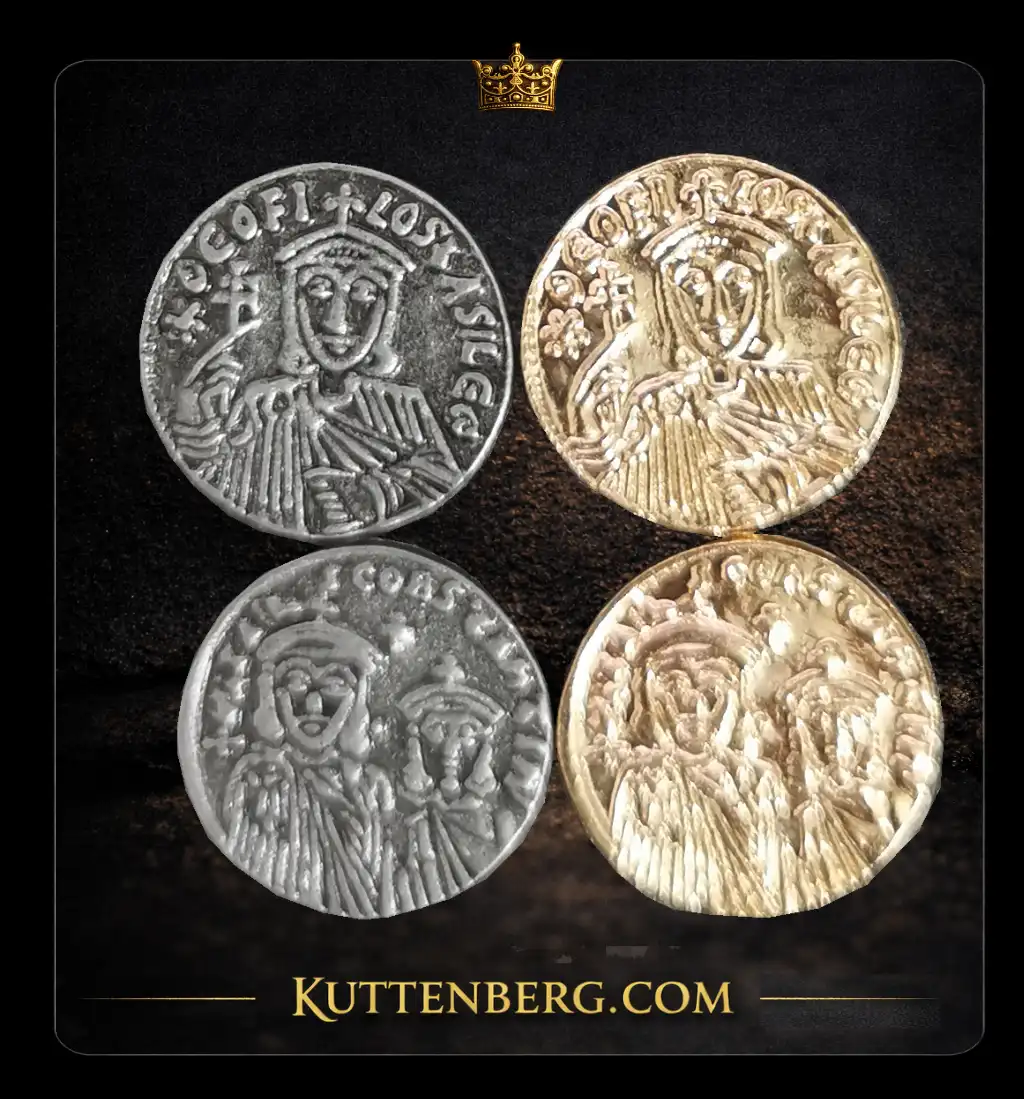
Solidus of Emperor Theophilus
The model for the replica is a Byzantine solidus found in the territory of Great Moravia.
It is a Byzantine solidus of Emperor Theophilus, minted approximately in 831–840 in Constantinople.
On the side with a single figure is:
Emperor Theophilus — Greek Θεόφιλος, ruled 829–842,
in his right hand he holds a patriarchal cross, in his left a pouch or scroll called an akakia,
the description reads approximately:
ΘЄOFI–LOS bASILЄ Θ
i.e. Theophilus basileus – “Theophilus, emperor”. The last Θ is an abbreviated part of the title and the description differs slightly between the mints.
On the other side are two figures:
on the left, the bearded Michael II, Theophilus’ father and previous emperor,
on the right, the smaller, beardless Constantine, Theophilus’ prematurely deceased son,
between their heads is a cross.
The description is:
MIXAHL S COhSTAhTIN
i.e. “Michael and Constantine”. The letter S here functions as a Greek or Byzantine “a”, not as the initial of another name.
Byzantine imperial iconography looks to today’s eyes almost the same as icons of saints: frontal rigid figures, halo-like crown, crosses, long robes and strong facial stylization.
Moreover, Michael and Constantine below appear as a pair of saints or apostles. In reality, however, this is an imperial family and political presentation – Theophilos on one side, his dynastic legitimacy on the other. On Byzantine coins, secular and sacred authority are deliberately visually almost merged.
Historical authenticity
Today, we are used to currency that changes regularly, with older coins quickly disappearing from circulation. In the Middle Ages, however, things worked very differently.
Coins often remained in circulation for decades, and it was completely normal for newly minted coins to be used alongside much older ones. For example, Prague groschen were used from the 14th century well into the time of the Thirty Years’ War.
Newer coins were often smaller and contained less precious metal, but older, higher-quality coins did not disappear. On the contrary – they were often valued even more.
In times of crisis, such as the Hussite Wars, minting could stop entirely. The Kutná Hora mint, one of the most important in Europe, was inactive for extended periods, which meant that coins already in circulation continued to be used for many years.
That is why it is historically accurate for different types and ages of coins to appear together in your game world – just as they did in reality.
Shipping & Delivery
We ship worldwide from the EU.
📦 Shipping cost
Shipping is fixed based on destination.
Because shipping cost is fixed, larger orders offer significantly better value.
🌍 Customs & duties
Orders within the EU are shipped without customs fees.
Shipping to the USA
We ship to the USA via our US partner. Your order is processed locally, no customs, no extra fee, you receive it as a domestic USPS shipment.
All customs handling is taken care of on our side — you won’t need to deal with any customs fees or import procedures.
Canada: No import duties. Local taxes may apply depending on your region.
For other non-EU countries (e.g. UK, Switzerland, Norway), customs charges may apply. We list the goods as “toy parts – metal token for games”, many countries have zero customs duties on them, but we do not guarantee what your customs office will decide.
🚚 Delivery time
Europe: 3–7 business days
USA: 10–14 days
Other countries: varies depending on location
📬 Shipping method
We use trusted carriers (Packeta, DHL, Hermes, Colissimo, GLS, UPS, USPS and other partners by country).
Tracking is provided for all orders.
💡 Tip
Because the real shipping costs are the same for 10 or 100 coins, it is advantageous to order more at once.
Most customers order 30–100 coins to make the most of shipping.
Italy — Gold of the Enemy
The tent was quiet, but not friendly.
Maps lay open between them. Italy, cut into lines that meant armies, not land.
The Theuderic leaned back.
“That is too little,” he said.
Totila didn’t answer immediately. He picked up a coin from the table.
A solidus.
He turned it slowly.
“Gold is gold,” he said. “Your men will be paid in it. And they will not complain.”
The Frank smiled faintly.
“No,” he said. “They won’t.”
He took the coin, weighed it in his hand.
“Then more of it.”
Silence again. Then a second pile was added.
The Gothic king exhaled.
“Agreed.”
They both looked at the coins for a moment.
Then the Frank laughed.
“We bargain,” he said, “in the coin of the man we both want to defeat.”
The Gothic king allowed himself a thin smile.
“That,” he said, “is why it works.”
Because empires fall.
But gold that is trusted does not.
Great Moravia — The Decision
The hall was filled, but no one spoke.
Not until he did.
Svatopluk I of Moravia stood at the front, looking not at the men — but at what lay before them.
Two coins.
One smaller. Familiar.
One gold.
The solidus.
“We can strike our own,” someone said. “Like the Franks.”
Svatopluk shook his head slightly.
“We can,” he said. “But trust is not struck. It is inherited.”
He picked up the gold coin.
“This,” he said, “is already accepted where our traders go.”
A pause.
“And where our enemies go.”
A few smiles.
He placed it back down.
“We will not teach the world a new coin.”
He looked around the hall.
“We will use the one the world already believes in.”
The decision was simple.
Because power is not only what you create.
It is what others already trust.
France — A Small Purchase
The street was narrow, but alive.
Boots on stone. Voices. Steel at the side.
A musketeer stepped to the stall and picked up a small loaf.
“How much?”
“Two,” said the baker.
The musketeer reached into his pouch and dropped the coins into the man’s hand.
Sou.
Small. Light. Ordinary.
The baker nodded and handed over the bread.
No hesitation.
No weighing.
The musketeer smiled slightly.
“Still works,” he said.
The baker shrugged.
“It always does.”
Because once, it had been gold.
A solidus.
And even now, long after the empire that named it was gone, the habit remained.
The coin had changed.
The trust had not.
Identity
Use silver groschen as the standard currency,
gold for high values,
patinated silver for low-value coins.
Design
Specifications
Usage
RPG
Board games and other games
Film- and Theaterrequisiten
Theme markets and similar events
Themen-Kinderlager
FAQ
Is the coin double-sided?
Yes, all our coins are double-sided.
Is it an exact replica of the original?
Yes, it is based on the real appearance of the historical coins.
What is the weight of one coin?
Approximately 10 grams.
What does the coin feel like?
Authentic, it is a metal coin.
Is the coin suitable for LARP or RPG?
Yes, it is made of a durable alloy and has safe rounded edges.
Is it a replica or fiction?
It is a fairly faithful historical replica created in real size based on a real coin from the time of emperor Rudolf II.
Can the coin also be used as a gift?
Yes, it is often used as a thematic trifle or collector’s item object.
Is the coin magnetic?
No
What is the lifespan of the surface treatment?
It depends on the way of use, in general – the lifespan is long.
Can the coin be used as real currency or an investment?
No — You can try, but we are afraid that you will not succeed, it has been withdrawn from circulation for a few centuries 🙂
This is a replica for games, collecting or as a prop (it is not minted from silver and has no real value as currency).
Safety Warning
This coin is not a toy.
Not suitable for children under 3 years – choking hazard (small parts).
Keep out of reach of small children.
Additional Safety Recommendations
-
The coin is metal and may be heavier than regular plastic coins tokens.
-
Do not use as an object for throwing or hitting.
-
Do not chew, do not put in mouth.
-
Not suitable for children under 3 years without adult supervision.
Coin maintenance and cleaning
Common cleaning
-
Wipe with a dry or slightly damp soft cloth.
-
If the patina is more pronounced, use a mild soap solution and dry thoroughly again.
-
Do not use abrasives or scouring pads — they can damage the surface treatment.
What not to do with a coin
-
Do not leave in moisture for a long time (you will extend the life of the patina and the surface).
-
Do not expose to aggressive chemicals (cleaning sprays, acids, acetone, polish remover).
-
Do not put in the dishwasher — heat and water pressure destroy the surface finish.
-
Do not leave in salt water (corrosive environment).
-
Do not put in pockets with keys — they quickly scratch the surface.
Long-term storage
-
Store in a dry place.
-
Ideally keep in a bag, box or envelope.
Related products
-
Coins for Napoleonic era Europe Imperiale
Price range: € 30,00 through € 370,00Select options This product has multiple variants. The options may be chosen on the product page -
Denarius of Charlemagne – metal replica
€ 0,80Select options This product has multiple variants. The options may be chosen on the product pagePricing and sales
Quantity Discount (%) Price 1 - 9 — € 0,80 10 - 99 25% € 0,60 100 - 499 40% € 0,48 500 - 999 50% € 0,40 1,000+ 53.75% € 0,37 -
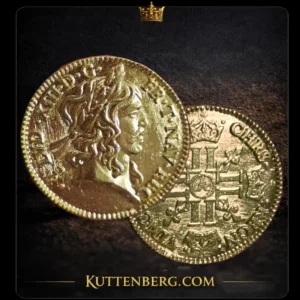
Louis d’Or – Three Musketeers Coin
€ 0,80Add to basketPricing and sales
Quantity Discount (%) Price 1 - 9 — € 0,80 10 - 99 25% € 0,60 100 - 499 40% € 0,48 500 - 999 50% € 0,40 1,000+ 53.75% € 0,37 -
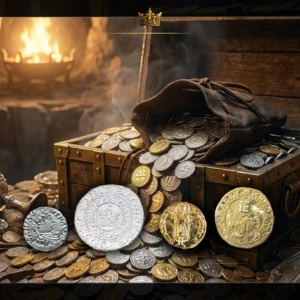
Medieval Royal Treasury – set of medieval gaming coins
Price range: € 30,00 through € 370,00Select options This product has multiple variants. The options may be chosen on the product page