Pièces de monnaie Saladin – Réplique en métal pour jeux
€ 0,80
Saladin Coins
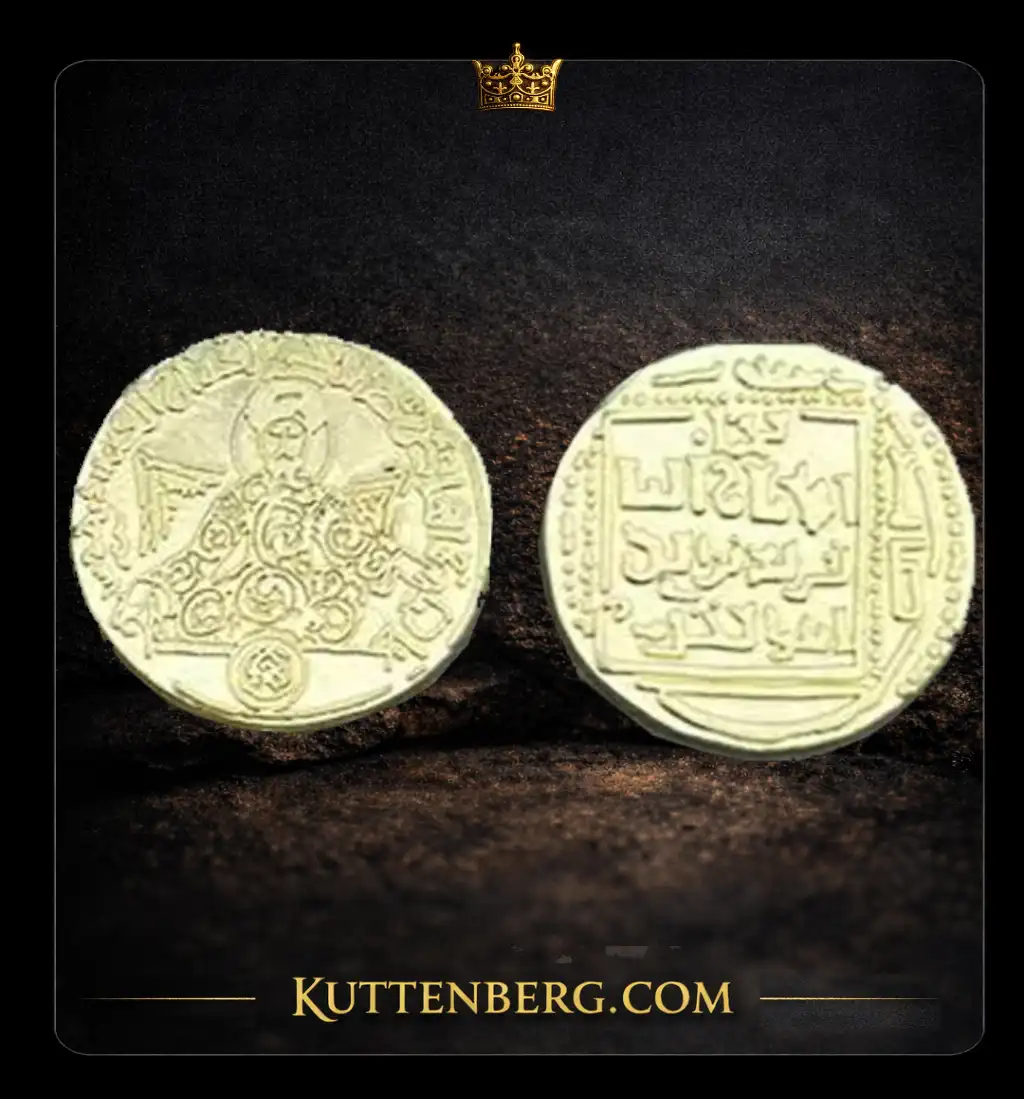
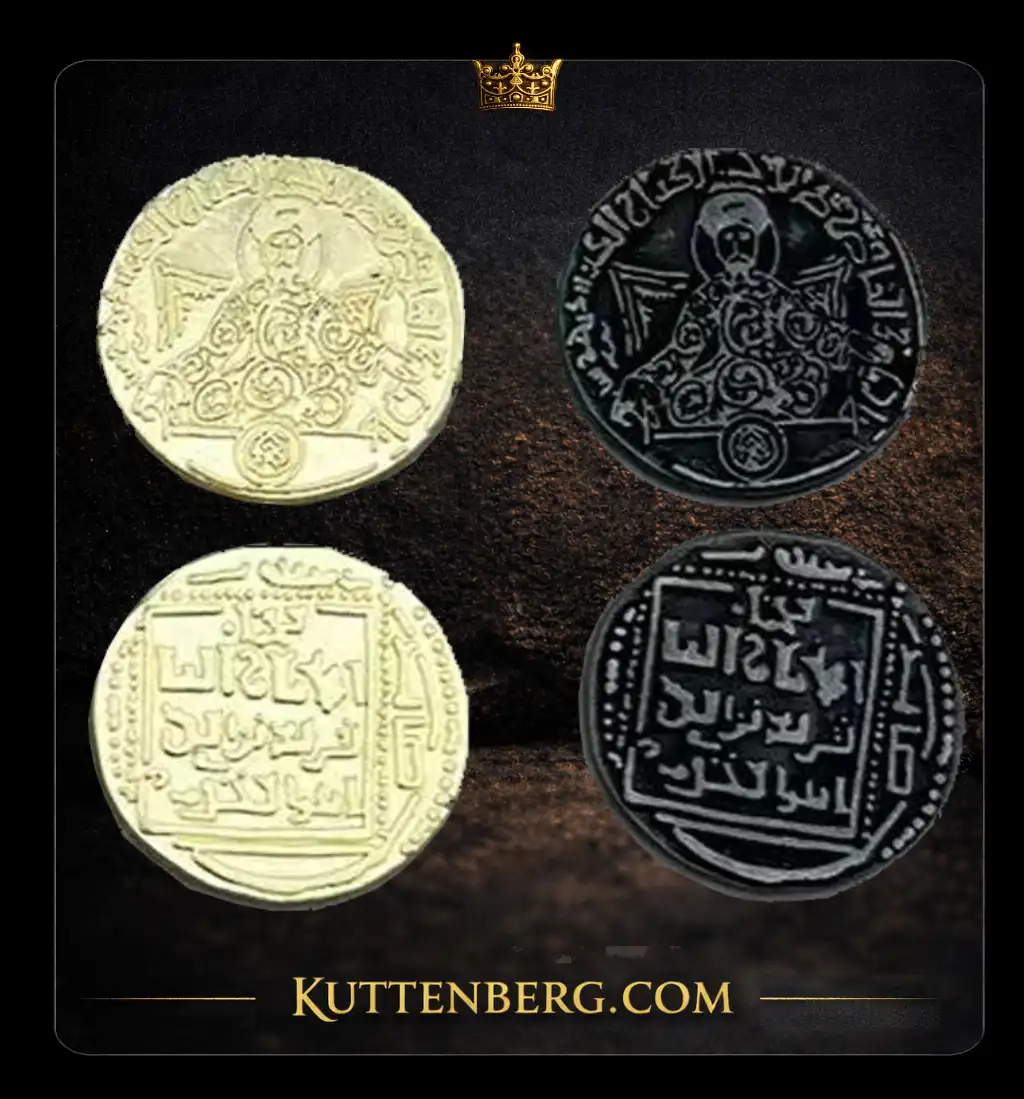
Saladin coins for games, available in gold and patinated silver. Other finishes (bright silver, copper, patinated copper) are possible for larger orders.
Diameter: 26 mm
Material: zinc alloy
This piece is a historical replica, combining the obverse of one coin and the reverse of another from the reign of Saladin. These coins were struck in his sultanate at the end of the 12th century, most likely in Cairo.
Parameter Value
Diameter 26 mm
Thickness approx. 2 mm
Weight approx. 4 g
Material Zinc alloy
Color variants Silver, Gold, Silver patina, Copper patina, Verdigris
Suitable for LARP, RPG, board games, gifts, props, etc.
Who is the coin for
It is a game coin for use in board games, cosplay, larp and rpg, in theater, etc. It is a game coin for use in board games, cosplay, larp and rpg, in theater, etc. It will be used, for example, by LARP players, RPG gamemasters, collectors of fantasy items and fans of epic mythology.
Uses of coin
Suitable as a game currency, trophy, collector’s item or atmospheric accessory to a costume.
Saladin Coins
Saladin coins for games, available in gold and patinated silver. Other finishes (bright silver, copper, patinated copper) are available for larger orders.
Diameter: 26 mm
Material: zinc alloy
This piece is a historical-style replica, combining the obverse of one coin and the reverse of another from the reign of Saladin. These coins were struck in his sultanate in the late 12th century, most likely in Cairo.
The reverse side carries a praise of God, while the obverse is unusual—and even controversial in the Islamic world—as it shows a portrait of Saladin himself. Only a ruler of his stature could afford such a bold departure from tradition.
A coin of power, faith, and legitimacy
Saladin’s coins (Ayyubid dinar / dirham) belong among the most important currencies of the late 12th century. They were minted at a time when Saladin unified Egypt and Syria, reshaping the political balance of the Middle East. Coins were not merely tools of trade—they were instruments of legitimacy and visible symbols of a new order.
This replica combines motifs from two historical coins of the Ayyubid Sultanate. Such an approach is common in modern historical replicas, aiming to capture the characteristic visual language of the period rather than reproduce a single surviving piece.
Typical Saladin coins were primarily epigraphic—dominated by text. They carried religious formulas, the ruler’s titles, and information about the mint and date (in the Hijri calendar). The inscription was not decorative—it was a public statement of political and religious authority.
After taking control of Egypt, Saladin also transformed its coinage. The removal of the Fatimid caliph’s name and its replacement with Sunni legitimacy was one of the most visible signs of regime change. Coins thus document the shift of power as clearly as chronicles.
Figural imagery is less common in Islamic coinage, but regional exceptions existed—and modern replicas sometimes use such elements to make the historical narrative more accessible and visually engaging.
Saladin’s coins circulated widely across the Mediterranean, along trade routes between the Islamic world and Europe, and even touched the economic environment of the Crusader states. They represent a world where trade, faith, and politics were deeply intertwined.
Key facts
- Coins were one of the primary tools of political legitimacy
- Saladin’s coinage reform symbolized the end of Fatimid Egypt
- Islamic coins often function as precise historical documents
- Epigraphic coins allow detailed tracking of political change
- Saladin’s coinage is among the most widespread of the Crusades era
Historical context
Saladin (Ṣalāḥ ad-Dīn, 12th century):
- Founder of the Ayyubid dynasty
- Unified Egypt and Syria
- Defeated the Crusaders at the Battle of Hattin
- Recaptured Jerusalem in 1187
- Built a new and legitimate political order
For Saladin, coins were more than currency—they were propaganda of legitimacy.
Types of Saladin’s coins
Saladin issued:
- gold dinars
- silver dirhams
- copper fulus
Typical features:
✔ religious inscriptions
✔ ruler’s name
✔ titles
✔ mint location
✔ date (Hijri calendar)
Coins as text — and message
Islamic coins are essentially “text objects.”
This means:
- a coin = a religious statement
- a coin = a political declaration
- a coin = legitimacy of rule
- a coin = a medium of communication
Trade and circulation
Saladin’s coins:
- circulated across the Mediterranean
- were accepted beyond the Islamic world
- were tied to long-distance trade
- interacted economically with Crusader states
Saladin vs. Crusader coinage
Coins from the Crusades era represent a unique meeting of two monetary traditions—Islamic and European. Although often in military conflict, these worlds influenced each other economically.
Saladin’s coins follow the Islamic epigraphic tradition. They are dominated by text—religious formulas, ruler titles, and mint information. The coin itself becomes a statement of legitimacy, faith, and continuity.
Crusader coins, on the other hand, follow European visual traditions. They often feature crosses, rulers’ portraits, heraldry, or symbolic imagery. Visual representation plays a much stronger role.
Interestingly, Crusader states gradually adopted Islamic monetary standards. Some Crusader coins imitate Islamic dinars so closely that they can only be distinguished through detailed study. The reason was practical—merchants trusted familiar standards of weight and purity.
This creates a striking paradox: coins of rival civilizations begin to resemble each other—because trade requires trust more than ideology.
Saladin’s coins represent the continuity of Islamic monetary tradition and the legitimacy of a unified sultanate, while Crusader coins show adaptation to the economic realities of the Near East.
Together, they depict a world where conflict and commerce existed side by side.
Summary
Saladin’s coins
- primarily textual (epigraphic)
- focus on legitimacy and faith
- continuity of Islamic tradition
- standard for long-distance trade
Crusader coins
- visual imagery (crosses, rulers)
- European iconography
- gradual adoption of Islamic standards
- hybrid style between two worlds
“Coins of the Crusades era show that even between rivals, a shared language existed—the language of trust in the weight of silver and gold.”
Authenticité historique
Aujourd’hui, nous sommes habitués à une monnaie qui change régulièrement, les pièces anciennes disparaissant rapidement de la circulation. Au Moyen Âge, la situation était très différente.
Les pièces restaient souvent en circulation pendant des décennies, et il était tout à fait normal que des frappes récentes coexistent avec des pièces beaucoup plus anciennes. Par exemple, les gros de Prague ont été utilisés du XIVe siècle jusqu’à la guerre de Trente Ans.
Les pièces plus récentes devenaient souvent plus petites et contenaient moins de métal précieux, mais les anciennes, de meilleure qualité, ne disparaissaient pas. Au contraire, elles étaient souvent particulièrement appréciées.
En période de crise, comme lors des guerres hussites, la production monétaire pouvait même s’arrêter complètement. La Monnaie de Kutná Hora, l’une des plus importantes d’Europe, a ainsi cessé de fonctionner pendant un certain temps, ce qui a prolongé l’usage des pièces existantes.
C’est pourquoi il est historiquement authentique que différentes pièces, de types et d’âges variés, se retrouvent ensemble dans votre univers de jeu – exactement comme dans la réalité.
In use
These coins are actively used in our games (http://akkon1291.com). With use, they naturally acquire wear and patina—making them even more convincing and immersive over time.
Expédition & livraison
Nous expédions dans le monde entier depuis l’UE.
📦 Frais de livraison
Les frais de livraison sont fixes (France et Belgique : 12 €).
Les commandes plus importantes offrent un meilleur rapport qualité/prix.
🌍 Douanes
Aucun frais de douane pour les commandes au sein de l’UE.
🚚 Délai de livraison
Europe : 3 à 7 jours ouvrés
Autres pays : variable selon la destination
📬 Expédition
Nous utilisons des transporteurs fiables (Colissimo, Packeta, DHL-PPL, GLS, UPS).
Un numéro de suivi est fourni pour chaque commande.
💡 Astuce
La plupart des clients commandent entre 30 et 100 pièces pour optimiser les frais de livraison.
Saladin and the Merchant
The tent was quiet, but not empty. Outside, the market could be heard — voices, animals, metal that rings the same in every language.
The merchant placed a small pouch on the low table. He was not nervous. Just careful.
Saladin sat opposite him, watching his hands rather than the goods.
“From Damascus,” said the merchant. “Glass, fabrics, dyes.”
Saladin nodded.
“And the price?”
The merchant poured out a few coins. Gold. Familiar.
“This is what the Franks pay with,” he said.
Saladin picked one up and turned it between his fingers. The cross was clear. The weight was right.
“And do they accept ours?” he asked.
The merchant smiled slightly.
“When they are good.”
Saladin reached into his own pouch and placed a dinar on the table. Text instead of image. A different language, the same metal.
The merchant placed both coins side by side and watched them for a moment.
“People are different,” he said at last. “Coins, less so.”
Saladin smiled, almost imperceptibly.
“Trade is more patient than war,” he said.
The merchant nodded. The coins disappeared back into the pouch — together.
Outside, the market continued, as if the world were not divided.
Because sometimes civilizations collide.
And sometimes, they simply compare the weight of gold.
The market
Later, no one asked where the coin had come from.
Not the spice seller.
Not the money changer.
Not the porter carrying sacks through the dust.
They weighed it.
They tested it.
They accepted it.
A coin passed from hand to hand, crossing languages, borders, and beliefs without hesitation.
Because trust does not follow flags.
It follows weight.
It follows metal.
It follows what can be held, tested, and known.
And in that moment, the world was simpler than the wars that divided it.
Not united.
But understandable.
Measured in gold.
Identity
Verwenden Sie Silbergroschen als Standardwährung,
Gold für hohe Werte,
patiniertes Silber für Münzen mit niedrigem Wert.
Design
Specifications
Usage
RPG
Brettspiele und andere Spiele
Film- und Theaterrequisiten
Themenmärkte und ähnliche Veranstaltungen
Themen-Kinderlager
FAQ
Ist der Prager Groschen beidseitig geprägt?
Ja, alle unsere Münzen sind beidseitig geprägt. Der Prager Groschen zeigt auf der Vorderseite einen böhmischen Löwen und auf der Rückseite die Königskrone, genau wie das Original.
Ist es eine exakte Nachbildung des Originals?
Ja, sie basiert auf der realen Form des Prager Groschens. Das Design ist eine Nachbildung der Münze Wenzels II. aus der ersten Prägung des Groschens kurz nach 1300. Größe und Gewicht entsprechen weitgehend dem Original.
Welche Inschriften befinden sich im Ring des Prager Groschens?
Auf der Vorderseite des Prager Groschens steht „GROSSI PRAGENSES“ (Prager Groschen). Auf der Rückseite steht im äußeren Ring „DEI GRACIA REX BOEMIE“ (Von Gottes Gnaden, König von Böhmen) und im inneren Ring „WENCEZLAVS SECVNDVS“. Spätere Prägungen des Prager Groschens wichen im Namen des Monarchen ab.
Wie viel wiegt eine Münze?
Ungefähr 7 Gramm.
Wie fühlt sich der Prager Groschen an?
Er fühlt sich wertig an, er ist aus Metall.
Kann er im LARP-Kampf verwendet werden?
Ja, man kann sie beispielsweise mit einer Steinschleuder werfen. Wir empfehlen sie jedoch als Zahlungsmittel, nicht als Waffe.
Ist die Münze für LARP geeignet?
Ja, sie besteht aus einer robusten Legierung und hat sichere, abgerundete Kanten.
Handelt es sich um eine Replik oder eine fiktive Figur?
Es ist eine detailgetreue historische Replik in Originalgröße, die einer echten Münze aus der Zeit Wenzels II. nachempfunden ist.
Kann die Münze verschenkt werden?
Ja, sie wird häufig als thematisches Geschenk oder Sammlerstück verwendet.
Ist die Münze magnetisch?
Nein.
Wie lange hält die Oberflächenbehandlung?
Das hängt von der Art der Verwendung ab, im Allgemeinen ist die Haltbarkeit jedoch lang.
Kann die Münze als echtes Geld oder als Wertanlage verwendet werden?
Nein – Sie können es versuchen, aber wir befürchten, dass es nicht klappen wird. Die Münze ist seit einigen Jahrhunderten außer Kurs gesetzt.
Dies ist eine Replik für Spiele, Sammler oder als Requisite (sie ist nicht aus Silber geprägt und hat keinen realen Wert als Zahlungsmittel).
Sicherheitshinweis
Diese Münze ist kein Spielzeug.
Nicht geeignet für Kinder unter 3 Jahren – Erstickungsgefahr (Kleinteile).
Außerhalb der Reichweite von Kleinkindern aufbewahren.
Zusätzliche Sicherheitshinweise
Die Münze ist aus Metall und kann schwerer sein als herkömmliche Plastikmünzen.
Nicht werfen oder schlagen.
Nicht kauen, nicht in den Mund nehmen.
Nicht geeignet für Kinder unter 3 Jahren ohne Aufsicht von Erwachsenen.
Pflege und Reinigung der Münze
Regelmäßige Reinigung
Mit einem trockenen oder leicht feuchten, weichen Tuch abwischen.
Bei stärkerer Patina eine milde Seifenlauge verwenden und anschließend gründlich trocknen.
Verwenden Sie keine Scheuermittel oder Stahlwolle – diese können die Oberfläche beschädigen.
Was Sie mit der Münze vermeiden sollten:
Lassen Sie die Münze nicht längere Zeit Feuchtigkeit aussetzen (dadurch erhalten Sie die Patina und die Oberfläche).
Setzen Sie die Münze keinen aggressiven Chemikalien aus (Reinigungssprays, Säuren, Aceton, Nagellackentferner).
Geben Sie die Münze nicht in die Spülmaschine – Hitze und Wasserdruck zerstören die Oberfläche.
Lagern Sie die Münze nicht in Salzwasser (korrosive Umgebung).
Tragen Sie die Münze nicht zusammen mit Schlüsseln in der Tasche – diese zerkratzen die Oberfläche schnell.
Langfristige Aufbewahrung:
An einem trockenen Ort aufbewahren.
Idealerweise in einem Beutel, einer Schachtel oder einem Umschlag.
Produits similaires
-
Pièce viking Raven Penny – monnaie de jeu pour LARP, RPG et jeux de société
€ 0,80Choix des options Ce produit a plusieurs variations. Les options peuvent être choisies sur la page du produit -
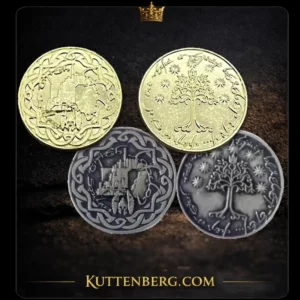
Celestar – Pièce de la Cité Blanche
€ 0,80Choix des options Ce produit a plusieurs variations. Les options peuvent être choisies sur la page du produit -
Set de monnaies – Europe de la Renaissance
Plage de prix : € 30,00 à € 370,00Choix des options Ce produit a plusieurs variations. Les options peuvent être choisies sur la page du produit -
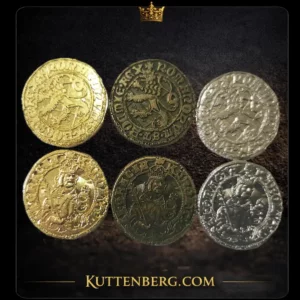
Ducat – monnaie d’or de Charles IV
€ 0,80Choix des options Ce produit a plusieurs variations. Les options peuvent être choisies sur la page du produitPricing and sales
Quantity Discount (%) Price 1 - 9 — € 0,80 10 - 99 25% € 0,60 100 - 499 40% € 0,48 500 - 999 50% € 0,40 1 000+ 53.75% € 0,37