A Brief Guide to the History of Coins from Ancient Times to Modern Times
Coins are one of the oldest economic tools — but also one of the most fascinating artifacts of human civilization.
Their evolution reflects technology, political power, trade networks and the aesthetics of each era.
This overview is not an exhaustive encyclopedia. It is a guided journey through the most important milestones in coin history, with a focus on coins that also make sense for games, LARP and the reconstruction of historical worlds.
7th century BC Lydia and the first coins
The first real coins appeared in Asia Minor, in the kingdom of Lydia. They were usually made of electrum — a natural alloy of gold and silver — or gold.
These early coins were often struck only on one side, while the reverse showed little more than an impression from the punch. They were not “beautiful” in the modern sense. Their main function was to guarantee the weight and purity of the metal.
Note
Great ancient empires (e.g. Egypt during the Ramesses era) did not use coins. The economy worked by weight of metal or in kind change
Celtic coins
- staters (often gold), sometimes called Iris coins, are still found throughout Europe
- very small
- stylized, sometimes even abstract
sometimes have a surprisingly “modern” appearance
Ancient world Greece, Rome and classical coinage
This is where coins begin to look like the coins we know today. Greek drachmas, especially Athenian ones, became important trade coins with detailed reliefs and high artistic value.
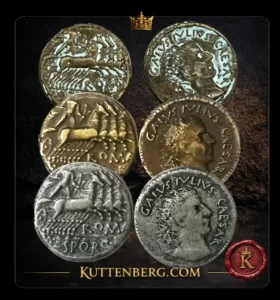
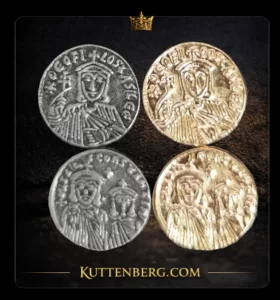
Rome created some of the most influential coins in European history: the silver denarius, silver, bronze or brass sestertius, gold aureus and later the gold solidus introduced after Constantine.
Roman coins often carried realistic portraits, standardization and symbols of power. They were money, but also political propaganda.
Other areas
- Carthagen coins
- Judean shekels
- Scythian coins
- Persian darics
👉 but in Europe the Greco-Roman model dominated
Early Middle Ages Denars and pennies
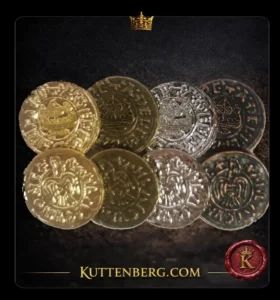
After the fall of Rome, coinage became simpler and more local. The most important early medieval coin was the silver denar, reintroduced and standardized under Charlemagne and , very simple to primitive in appearance.
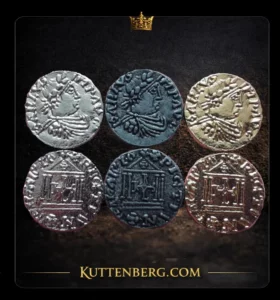
In England and the Viking world, the penny played a similar role. Early coins were small and simple, but some later types, such as the Raven penny, became visually distinctive.
High Middle Ages Groschen, florins and ducats
The High Middle Ages brought more varied and more beautiful coinage.
In Iberian Peninsula had silver real, its multiples derived from it, the most famous is the Pieces of eight, gold escudo, the double escudo is known from Dumas’ novels as a doubloon and maravedi – originally a coin adopted by the Arabs, later became a small currency made of beaten silver or copper
In France, Louis IX introduced new coins such as the écu and the gros tournois, a large silver coin that later inspired the Prague groschen. The solidus, however, remained in circulation for a long time, only it was no longer gold but often copper and its name was shortened to “sou” – that’s how we know it from many books.
In England, the penny is a staple, and the shilling and the large gold noble coin
In Central Europe
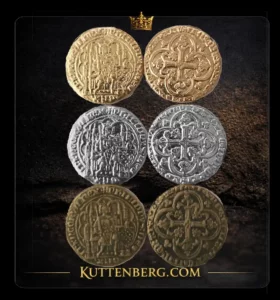
Bracteates was an attempt to replace the often counterfeited denarius with the brectate. The brectate was used during the 13th century and was not very popular. It was a thin one-sided coin roughly struck from thin sheet metal. Has reverse side = negative of the obverse, its interesting, but impractical
Prague Groschen (13th–14th century)
In 1300, they were found on the site of today’sKutný Hora was at that time the largest silver deposit in the world. Wenceslas II began minting a new, high-quality coin, using the Tour groschen as a model. His Prague Grosz became one of the most important coins of Central Europe in the 14th and 15th centuries.
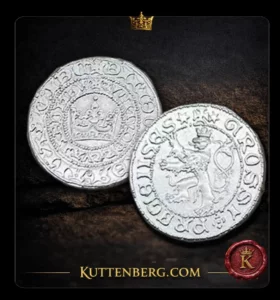
Prague grschen is large silver coin, high-quality minting,, wide distribution.
the Prague groschen became one of the most important coins of the 14th and 15th centuries. It was a large, high-quality silver coin minted after the discovery of rich silver deposits near Kutná Hora.
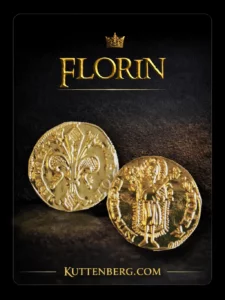
Gold coins also became increasingly important. Italian florins and ducats spread across Europe, and the ducat remained a prestigious high-value coin for centuries. Ducat – promoted by Charles IV and used gold from the gold mines in Kremnica (Slovakia) became the standard for centuries. Ducats as a “flagship” with a high nominal value were minted by monarchs and important nobles until modern times.
15th century Wars, devaluation and small coins
The 15th century was marked by long conflicts such as the Hussite Wars, the Hundred Years’ War and the Wars of the Roses. These conflicts damaged economies and coinage alike.
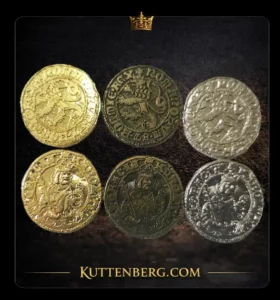
In Bohemia, the Kutná Hora mint stopped working during the Hussite Wars, and later groschen were often debased and poorly struck. Smaller coins such as parvus, half-groschen and copper pieces became much more common in daily circulation. The Kutná Hora mint did not work, the grosze minted before the war by Wenceslas IV. were devalued and contained more copper than silver, and their minting was of poor quality. Even the coins from that time that have survived to this day are not pretty. The standard of an honest groschen was therefore still considered the groschen of Wenceslas II.
Smaller coins (parvus, half-groschen) became much more widespread, because groschen, especially the high-quality one, were unaffordable for many people. Copper coins (e.g. “flutes” with a chalice) – their design and quality of minting were very poor, but these were the coins that were in circulation the most.
16th century The thaler and global trade
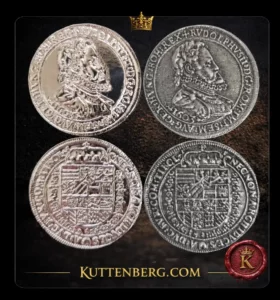
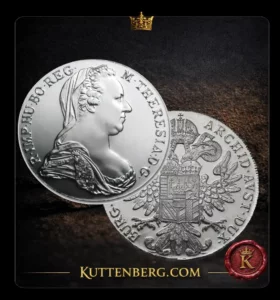
The thaler was one of the great milestones of early modern coinage. It was a large silver coin of high value and reliable composition, widely accepted not only in Central Europe but also in international trade.
The thaler later influenced the name and concept of the dollar. In many colonies and trading regions, large silver coins became trusted carriers of value.
Gulden / gold is a gold coin minted in the Netherlands and was a valued coin that was gladly accepted by merchants and sailors around the world. It was use for accounting and real currency and used in various variants
Everyday money Hellers, small change and ordinary life
Large silver and gold coins are impressive, but everyday life depended on small coins. In Central Europe, especially in German-speaking lands, the heller became one of the most common small denominations.
Groschen could be a craftsman’s wage. Ducats could buy political influence or estates. But bread, beer and small services were paid for with small coins such as hellers, parvus or copper pieces.
17th century Technological revolution – Machine minting and the Louis d’Or
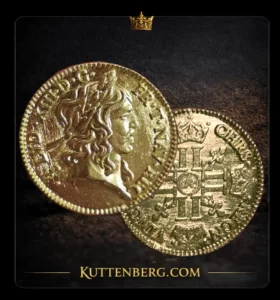
Under Louis XIV, French coinage moved toward machine minting. This brought much higher quality, greater uniformity and better protection against fraud. Louis had his own version of the Écu minted, and because it had a nice portrait of himself on the obverse, it became known as the Louis ‘or. The name écu then came to be used for the silver coin. The Louis d’or, as a high-quality gold coin, was then distributed throughout Europe with French soldiers during the Thirty Years’ War.
The Louis d’Or, a high-quality gold coin, had a milled edge that helped prevent clipping and counterfeiting. It already had many features of modern coinage.
French Revolution The franc and modern denominations
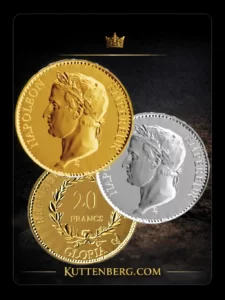
After the French Revolution, France introduced a new monetary system based on the franc. The franc was standardized, practical and issued in several denominations. The Franc was a high-quality and standardized currency in several values (the most famous is Napoleon’s gold twenty-franc). Because it had different denominations, it was excellent for wide use and easily spread – and with it the new principle spread – to have one currency with a standardized and systematized system of values, as we know coins today.
Napoleon’s gold 20 franc became one of the most famous examples. The franc helped spread the modern idea of a unified currency with a systematic set of values.The Frank is sometimes referred to as the “first European currency” or the predecessor of the Euro
Modern world The dollar
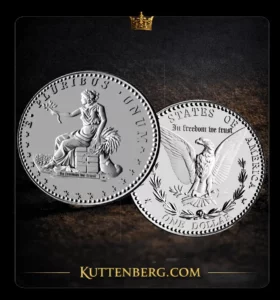
After the creation of the United States, the American dollar emerged from the tradition of large silver trade coins. It was influenced both by the Central European thaler and the Spanish piece of eight.
The earliest dollars were copper, but the silver dollar gradually became the standard. The silver dollar became the classic image of American money, although gold variants also existed. Over time, the dollar became one of the most influential currencies in the world.
What does this mean for games and game coins?
From a historical perspective, absolute accuracy is not always necessary. Coins often remained in circulation for years or even decades after they were minted, and different types of coins were commonly mixed in real economies.
For games, LARP and fantasy worlds, the most important things are:
- consistent style
- clear scaling of value
- believability
Conclusion
Coins are not just a medium of exchange. They are bearers of history, symbols of power and one of the best tools to bring a game world to life.
Whether you are building a historical LARP, a fantasy world or a board game, the right coins can do more than a complex rule.
- A Brief Guide to the History of Coins
- How to choose the right coins for your game
- How to Use Coins in Games
- How to Design a Game Economy
- How many coins do you need
- LARP Coins & Game Economy – FAQ